The climate crisis is reshaping coastlines, destroying wildlife habitat, driving extreme weather, and threatening the food and water security of hundreds of millions of people. But here is what the doom-and-gloom coverage often misses: the world is responding. From the ocean floor to rooftops to working lands, real climate change solutions are scaling and proving results across the globe.
This list highlights 11 of the most impactful climate solutions operating right now in 2026. These are measurable, trackable interventions already bending the curve on global carbon emissions and building climate resilience for communities worldwide.
Key Takeaways
- Coral reef restoration is transforming restoration timelines from decades to months.
- Renewable energy now generates more electricity than coal in many markets worldwide.
- Nature based solutions like reforestation and blue carbon protection can store carbon at meaningful scale while supporting biodiversity.
- Energy efficiency improvements in buildings and industry represent the fastest and cheapest path to reduce emissions.
- Electric vehicles, clean energy policy, and heat pumps are all accelerating emissions reductions across the transport and buildings sectors.
1. Coral Reef Restoration: Climate Solutions for the Ocean
Coral reefs cover less than one percent of the ocean floor but support roughly 25 percent of all marine species. They protect coastlines from storm surge, generate hundreds of billions in tourism and fisheries value, and sustain the food security of hundreds of millions of people in low income communities across the tropics. Yet decades of warming oceans, ocean acidification from rising carbon dioxide levels, and local stressors have wiped out roughly half of the world’s reefs since the 1950s.
Coral Vita is one of the world’s leading coral reef restoration companies, operating land-based coral farms that grow corals up to 40 times faster than traditional in-ocean methods. Since launching operations in 2019, Coral Vita has grown over 100,000 corals across 52 species in The Bahamas, Saudi Arabia, and the UAE. Its BrainCoral platform, recognized by TIME Magazine as one of the Best Inventions of the year, enables measurable, trackable impact for every coral planted. The company won the prestigious Earthshot Prize and raised an $8 million Series A led by Builders Vision, positioning it as a global leader in restoration-as-a-service for governments, corporations, and conservation partners.
What makes this climate action different is scale and speed. Coral Vita’s approach transforms restoration timelines from decades to months, with strong survivorship rates even under warming ocean conditions. As climate impacts on reefs intensify, this kind of climate resilience infrastructure is no longer optional. It is essential.
2. Clean Energy: Solar, Wind, and the End of Fossil Fuels Dominance

The clean energy transition is the single largest lever available to reduce carbon emissions globally. Burning fossil fuels for electricity and heat accounts for the largest share of greenhouse gas emissions in the world. Replacing fossil fuels with solar, wind, and other renewable energy sources attacks the problem at its root.
Solar capacity additions broke records in 2025 for the fifth consecutive year. The cost of solar has fallen over 90 percent in a decade, making it the cheapest electricity source in history. Wind energy is surging offshore and on land, while battery storage is solving intermittency challenges at scale. The fossil fuel industry is losing market share in power generation year over year, and the Paris Climate Agreement continues to drive renewable energy commitments from global leaders.
3. Reforestation and Nature Based Solutions to Combat Climate Change
Forests absorb carbon dioxide, store carbon in biomass and soils, regulate local climates, and protect wildlife habitat for thousands of species. Reforestation and forest protection are among the most cost-effective nature based solutions to tackle climate change today.
Initiatives like the Bonn Challenge and the UN Decade on Ecosystem Restoration have mobilized governments, corporations, and indigenous peoples to restore hundreds of millions of hectares of degraded forest. Studies from the Intergovernmental Panel on Climate Change confirm that nature based solutions including reforestation, improved land management, and halting deforestation could contribute roughly a third of the emissions reductions needed to limit warming to 1.5 degrees Celsius.
4. Energy Efficiency: Using Less Energy to Do More
The cleanest energy is the energy you do not use. Improving energy efficiency across buildings, industry, and transport reduces the total energy consumption of the global economy, meaning less energy needs to be generated in the first place. This lowers greenhouse gas emissions, cuts energy costs, and reduces pressure on the grid.
Advances in building insulation, LED lighting, industrial heat recovery, and smart grid technology are delivering huge amounts of energy savings globally. The International Energy Agency consistently identifies energy efficiency as the most cost-effective path to reduce emissions near term. For everyday people, it also means lower electricity bills and healthier homes.
5. Electric Vehicles and Clean Transportation Climate Action
Transportation accounts for roughly 16 percent of global carbon emissions, with the vast majority coming from road vehicles burning oil and gas. Electric vehicles are rapidly replacing internal combustion engines in passenger cars, buses, and increasingly in freight transport.
Global electric vehicle sales surpassed 17 million units in 2024 and are climbing further in 2026 as battery prices fall and charging infrastructure expands. Paired with public transportation expansion, electrifying mobility is one of the clearest paths to address climate change in cities while improving public health and air quality in low income communities that have long borne the brunt of pollution from oil and gas drilling.
6. Blue Carbon Ecosystems and Ocean-Based Climate Resilience
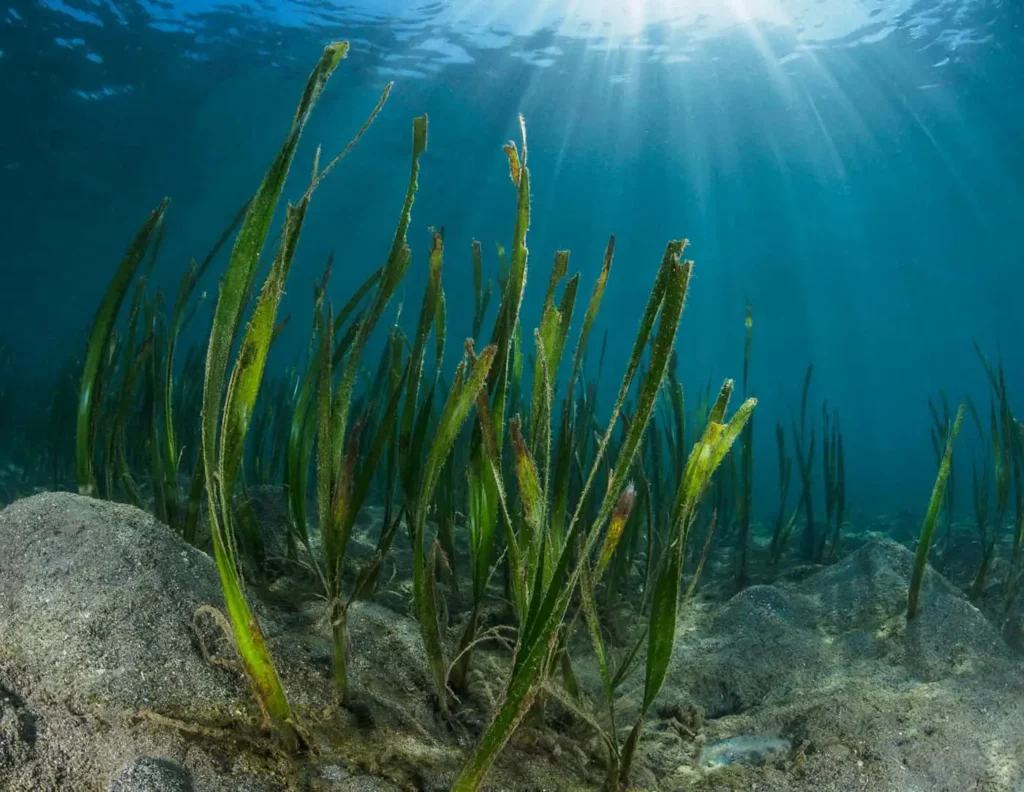
Coastal ecosystems including mangroves, seagrasses, and salt marshes store carbon at rates far exceeding terrestrial forests per unit area. These blue carbon habitats also buffer coastlines against sea level rise and extreme weather, support fisheries, and protect the natural resources that coastal communities depend on.
Protecting and restoring blue carbon ecosystems is gaining traction as part of international cooperation on climate change mitigation. Carbon markets are increasingly recognizing blue carbon credits, creating financial incentives to protect habitats that would otherwise be lost. These nature based solutions store carbon while delivering climate adaptation benefits for vulnerable coastlines around the planet.
7. Heat Pumps and Building Decarbonization for Energy Efficiency
Heating and cooling buildings accounts for roughly 10 percent of global carbon emissions. Most of this comes from burning gas in furnaces and boilers. Heat pumps offer a cleaner alternative: they use electricity to move heat rather than generate it, making them two to four times more energy efficient than gas heating systems.
Heat pump sales are accelerating globally, driven by rising gas prices, government incentives, and growing awareness of the health impacts of indoor gas combustion. As electricity grids get cleaner, heat pumps become progressively lower carbon over time. Combined with better insulation, they can dramatically cut energy consumption in buildings while keeping occupants warmer and healthier.
8. Carbon Capture Technology for Limiting Global Warming
Even with aggressive emissions reductions, the Intergovernmental Panel on Climate Change projects that carbon removal will be necessary to limit warming to safe levels. Carbon capture technologies range from direct air capture machines that pull carbon dioxide from the atmosphere to enhanced weathering, biochar, and carbon storage in soils and working lands.
While direct air capture remains expensive at scale, costs are falling and several large-scale facilities came online between 2024 and 2026. Nature based carbon capture through forests, wetlands, and ocean ecosystems remains the most cost-effective approach near term, while engineered solutions scale up to address the more carbon that needs to be removed from the atmosphere in coming decades.
9. Regenerative Agriculture and Working Lands Climate Solutions
Food and agriculture systems account for roughly a quarter of global greenhouse gas emissions when land use change, livestock, fertilizer, and food waste are included. Transforming how the world grows food offers both mitigation and adaptation opportunities.
Regenerative agriculture practices including cover cropping, reduced tillage, rotational grazing, and agroforestry rebuild soil health, increase water retention, and store carbon in the ground. Working lands managed regeneratively build resilience to drought and extreme weather in a changing climate. Indigenous peoples have long practiced land stewardship that aligns with regenerative principles, and international cooperation is increasingly centering these knowledge systems in climate solutions.
10. Green Building Standards and Sustainable Urban Climate Action
Buildings are responsible for roughly 37 percent of global carbon emissions when construction and operational energy are combined. Green building standards like LEED and BREEAM are pushing new construction toward net-zero energy consumption, while retrofit programs are upgrading older building stock worldwide.
Cities are emerging as key engines of climate action. Urban planning that integrates green spaces, promotes public transportation, and mandates high-performance building standards can dramatically cut emissions in the communities where most of the world’s population lives. Green buildings also deliver human health benefits through better air quality, thermal comfort, and access to natural light.
11. Clean Cooking: Climate Solutions for Low Income Communities and Public Health
Approximately 2.3 billion people worldwide still cook with solid fuels over open fires. This produces huge amounts of black carbon and other short-lived climate pollutants, contributing to global warming while causing indoor air pollution that kills millions annually and disproportionately harms women and children.
Clean cooking solutions including improved biomass cookstoves, liquefied petroleum gas, biogas, and electric induction cooking reduce greenhouse gas emissions, protect forest resources from overcollection, and dramatically improve public health. The transition to clean cooking is one of the highest-return climate change solutions available, particularly for low income communities in sub-Saharan Africa, South Asia, and Latin America.
The Planet Needs All of These Climate Change Solutions Working Together
No single technology or policy will stop climate change on its own. Limiting global warming to 1.5 degrees Celsius requires all of these solutions scaling simultaneously across every sector of the global economy. The evidence of 2026 is that this is possible.
From coral reefs to clean energy, from working lands to urban transit, the world’s climate solutions toolkit is deeper and more proven than ever. Everyday people, global leaders, corporations, indigenous peoples, and the wider global community all have a role to play. The question is not whether the solutions exist. They do. The question is whether we move fast enough.
At Coral Vita, we believe in optimistic realism: honest about the scale of the challenge, clear-eyed about urgency, and committed to the work of restoration. The ocean’s future is not written yet. Help us protect it.
About Coral Vita
Coral Vita is a mission-driven company dedicated to restoring our world’s dying and damaged reefs. Using innovative land-based farming techniques, Coral Vita grows diverse and resilient corals in months instead of the decades they take in nature. These corals are then transplanted into threatened reefs, helping to preserve ocean biodiversity while protecting coastal communities that depend on healthy reefs for protection, food, and income.
Founded by environmental entrepreneurs Sam Teicher and Gator Halpern, Coral Vita’s high-tech coral farms incorporate breakthrough methods to restore reefs in the most effective way possible. In 2021, the company was recognized as the inaugural winner of Prince’s William’s Revive Our Oceans Earthshot Prize Winner for their pioneering work in coral restoration.
To learn more about Coral Vita’s work or to get involved in coral reef conservation efforts, visit their website at www.coralvita.co or contact them directly through their Contact Us page.
Frequently Asked Questions
What are the most effective climate change solutions available today?
The most effective climate change solutions combine renewable energy deployment, energy efficiency improvements, nature based solutions like reforestation and reef restoration, electric vehicles, heat pumps, and regenerative agriculture. No single solution is sufficient alone.
How does coral reef restoration help address climate change?
Coral reef restoration protects marine biodiversity, supports coastal climate resilience, and defends communities from storm surge. Companies like Coral Vita grow heat-tolerant corals at scale, transforming restoration timelines and building reef resilience under a changing climate.
What role do nature based solutions play in climate change mitigation?
Nature based solutions like forests, wetlands, and coral reefs store carbon, regulate climate, and protect biodiversity. The Intergovernmental Panel on Climate Change estimates they could provide up to a third of required emissions reductions by 2030.
How can everyday people take climate action?
Everyday people can reduce emissions by switching to renewable energy, eating less meat, using public transportation or electric vehicles, improving home energy efficiency, and supporting organizations working on proven climate solutions like coral reef restoration.
What is the fossil fuel industry’s role in the climate crisis?
Burning fossil fuels from oil and gas drilling is the leading driver of global carbon emissions and climate change. Transitioning away from fossil fuels toward clean energy is the central challenge of climate change mitigation in the coming decades.