The climate crisis is driving one of the largest waves of technological innovation in history. From the depths of the ocean to the steel mills of northern Europe, climate tech companies are rethinking how the world produces energy, builds infrastructure, and manages waste. Investment in climate tech reached $40.5 billion globally in 2025, and the sector is maturing: investors are backing fewer companies but writing larger checks for those with proven technologies and real commercial deployment.1
The top climate tech companies of 2026 are not just developing innovative solutions in labs. They are deploying them at scale and building the clean energy economy a warming world needs. Despite some limited sales cycles and long commercialization timelines in hard-to-abate sectors, these companies are delivering proven climate solutions that no other industry can match. This list covers the greentech companies doing the most consequential work right now2.
Key Takeaways
- Coral Vita leads ocean-based climate tech with land-based coral farming that transforms reef restoration timelines from decades to months.
- Form Energy’s iron-air batteries are solving long-duration energy storage, enabling renewable energy to power data centers and utilities for up to 100 hours.
- CarbonCure has permanently embedded nearly 750,000 metric tons of CO2 into concrete across more than 10 million truckloads worldwide.
- Circular economy solutions from Redwood Materials are closing the loop on critical minerals, reducing greenhouse gas emissions from battery production by up to 70 percent3.
1. Coral Vita: Top Climate Tech Companies Restoring the Ocean
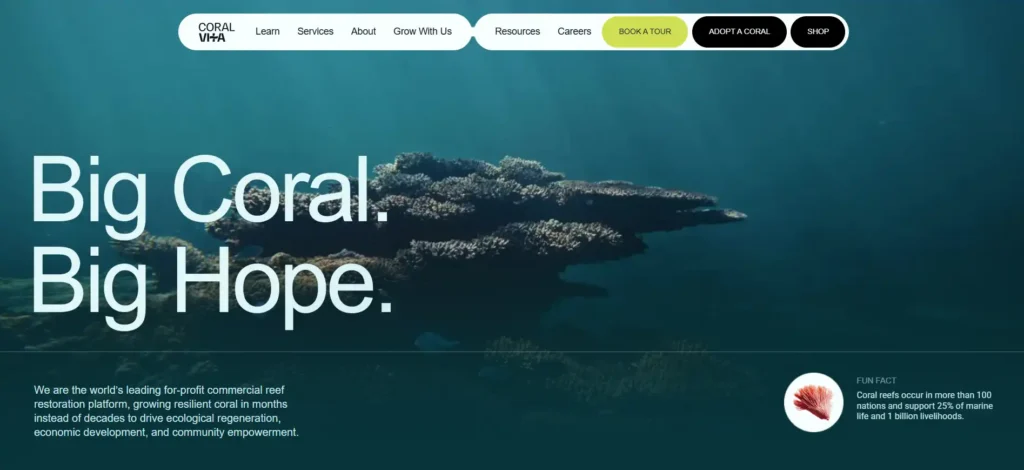
Coral reefs support a quarter of all marine species, protect hundreds of millions of people from coastal flooding, and underpin fisheries and tourism economies worth hundreds of billions annually. Ocean warming and acidification have already destroyed roughly half of the world’s reefs, and without intervention, up to 90 percent could be severely degraded by 20504.
Coral Vita is one of the world’s most innovative climate tech startups operating at the intersection of marine science and environmental restoration. Its land-based coral farms grow corals up to 40 times faster than conventional methods, with strong survivorship rates and corals bred for resilience to warming oceans. Since launching in 2019, Coral Vita has grown over 100,000 corals across 52 species in The Bahamas, Saudi Arabia, and the UAE.
The company is an Earthshot Prize winner and a TIME Magazine Best Inventions honoree for its BrainCoral platform, which delivers measurable, trackable impact for every coral outplanted. Coral Vita raised an $8M Series A led by Builders Vision and is scaling a restoration-as-a-service model for governments, corporations, and conservation partners5. As the climate impacts on coral reefs intensify, this work represents essential infrastructure for ocean-dependent communities worldwide.
2. Form Energy: Solving Long-Duration Energy Storage for Clean Energy Grids
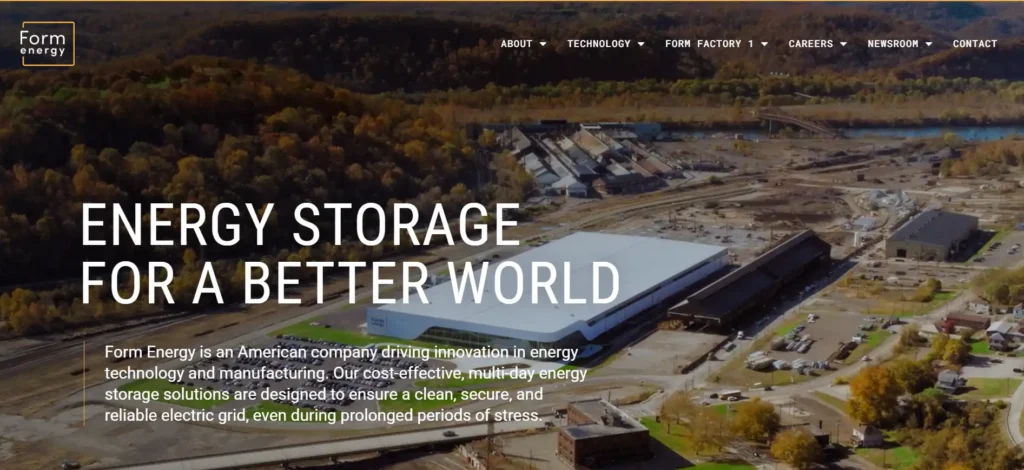
One of the biggest barriers to a fully renewable energy grid is electricity storage. Solar and wind generate clean power intermittently, but energy grids need reliable supply around the clock. Conventional lithium ion batteries store four to eight hours of energy. Fossil fuels have historically filled the gaps. Form Energy is changing that with iron-air batteries that store electricity for up to 100 hours using abundant materials: iron, water, and air. The system works through reversible rusting, making it a direct alternative to natural gas peaker plants6.
Form Energy has raised over $1.2 billion from investors including GE Vernova and Breakthrough Energy Ventures7. In early 2026, the company signed deals to supply multi-day electricity storage for data centers operated by Google and AI infrastructure firm Crusoe. With commercial deployments live across multiple US states, Form Energy is among the most consequential climate tech companies in energy storage today8.
3. CarbonCure: Climate Tech Innovation in Cement Production
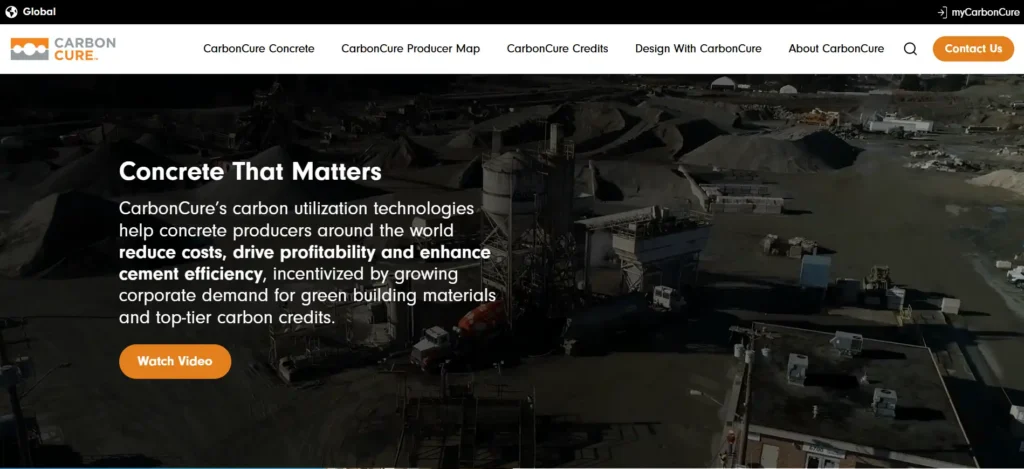
Cement production accounts for roughly eight percent of global greenhouse gas emissions. CarbonCure Technologies has developed a practical solution already at scale: injecting captured carbon dioxide into fresh concrete during mixing, where it permanently mineralizes into the material. This process stores carbon and strengthens the concrete, allowing producers to reduce cement per batch without compromising performance.
CarbonCure’s technology has been used in more than 10 million truckloads of concrete across nearly 30 countries. Named Climate Technology Company of the Year at the 2026 CleanTech Breakthrough Awards, the company has achieved nearly 750,000 metric tons of permanently utilized CO2 across its network of concrete plants. It is one of the clearest examples of carbon removal reaching meaningful commercial deployment9.
4. Cemvision: Greentech Companies Reinventing Cement Without Fossil Fuels

Where CarbonCure reduces the carbon intensity of existing cement production, Swedish startup Cemvision is reinventing cement from the ground up. Conventional Portland cement production requires heating limestone to extremely high temperatures using fossil fuels, releasing CO2 both from energy combustion and from the chemical reactions themselves. Cemvision’s process can cut emissions by up to 95 percent compared to traditional cement production10.
Cemvision uses waste materials including slag from steel plants and mine tailings as inputs, replacing virgin limestone. It electrifies the heating process using plasma, hydrogen, and electricity rather than burning natural gas or coal. The result is a cement product with circular economy solutions built into its very composition. In 2025, Cemvision signed a commercial agreement with Vattenfall to supply near-zero-carbon cement for wind farm construction projects across Europe, with deliveries from its first industrial-scale plant scheduled for 202811.
5. Redwood Materials: Circular Economy Solutions for EV Batteries
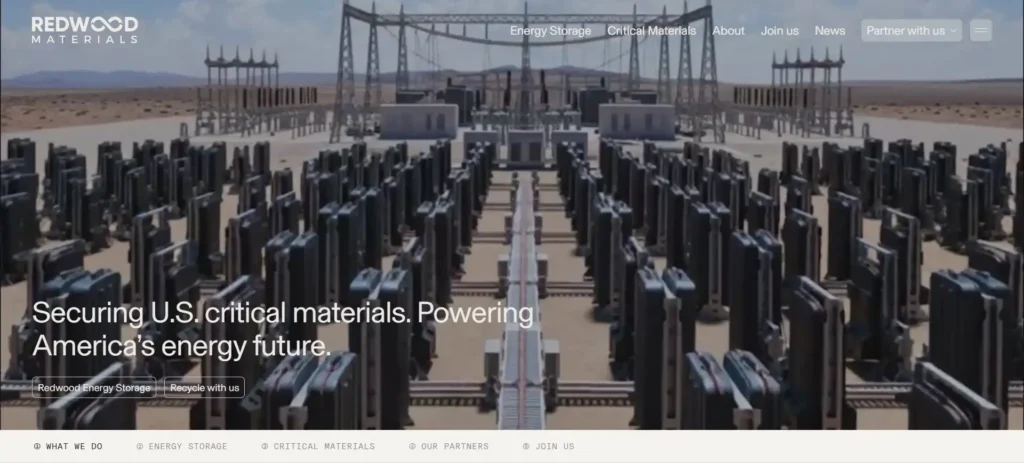
Electric vehicles are essential to reducing transportation emissions, but the mining of critical minerals for lithium ion batteries creates significant environmental and supply chain risks. Redwood Materials, founded by former Tesla co-founder JB Straubel, is building the circular economy infrastructure that the EV transition requires.
The company recovers over 95 percent of critical minerals from end-of-life batteries and remanufactures them into battery components supplied back to US manufacturers. Compared to traditional mining and processing, Redwood’s approach uses 80 percent less energy, generates 70 percent fewer greenhouse gas emissions, and requires 80 percent less water. As electric vehicles reach end of life and ev charging infrastructure expands, Redwood is positioned at a critical node in the clean energy economy, reducing dependence on virgin mineral extraction and strengthening domestic supply chains12.
6. Rumin8: Climate Tech Startups Tackling Agriculture Emissions

Livestock agriculture accounts for roughly 14.5 percent of global greenhouse gas emissions, with a significant share from the methane produced in the digestive systems of cattle and other ruminants. Methane is around 80 times more potent than carbon dioxide over a 20-year window, making livestock emissions one of the fastest levers for reducing near-term global warming.
Australian climate tech company Rumin8 has developed a synthetic feed additive that replicates the methane-inhibiting compounds found in a specific red seaweed species. Unlike seaweed farming, Rumin8’s product is scalable and consistent, working within existing livestock management practices. The company has set a goal of decarbonizing 100 million cattle by 2030.
7. Remora: Mobile Carbon Removal for Heavy Transport

Electrifying heavy-duty trucking remains technically challenging. Remora, a US climate tech startup, addresses emissions from existing diesel fleets by attaching carbon capture equipment directly to truck tailpipes, capturing CO2 before it enters the atmosphere.
Remora’s proprietary adsorbent technology is designed for the humid, variable conditions of real truck exhaust. Captured CO2 is offloaded at depots for storage or utilization. The company has raised $117 million and is advancing toward commercial deployment, targeting one of the hardest-to-abate sources of transport emissions and offering near-term emissions reductions for fleets that cannot yet switch to electric vehicles.
8. Stegra: Climate Tech Leading Green Hydrogen and Clean Steel
Steel production accounts for around seven percent of global greenhouse gas emissions, almost entirely due to coal use in blast furnaces. Stockholm-based Stegra is building one of Europe’s first large-scale green steel plants in northern Sweden, replacing coal with green hydrogen produced on-site using renewable electricity. The process emits water instead of carbon dioxide, cutting emissions by around 95 percent.
Stegra has secured nearly 6.5 billion euros in funding and pre-sold a majority of its initial output to industrial customers including Mercedes-Benz. The plant is a flagship for hard-to-abate industrial decarbonization and proof that green hydrogen can enable deep emissions reductions in heavy industry at commercial scale.
9. AiDASH: Data Centers and Energy Grid Resilience Through Climate Tech

As climate change drives more extreme weather, the reliability of energy grids is increasingly at risk. Wildfires, floods, and ice storms threaten power infrastructure at massive scale. AiDASH uses satellite imagery and artificial intelligence to help utilities manage infrastructure risk across vast service territories.
The platform analyzes vegetation growth and climate risk data to enable energy optimization and proactive maintenance, reducing outage risk. It improves grid reliability while cutting the cost and footprint of maintenance operations. AiDASH is a clear example of data-driven climate tech making energy grids more resilient to a changing climate without requiring new physical infrastructure.
10. Sunfire: Greentech Companies Scaling Green Hydrogen Production

Green hydrogen offers a pathway to decarbonize industries where direct electrification is difficult: steel, chemicals, shipping, and aviation. Dresden-based Sunfire is one of the world’s leading electrolyser manufacturers, producing both pressurized alkaline and high-temperature solid oxide systems for industrial-scale hydrogen production.
Sunfire’s technology is deployed across Europe and internationally, with a growing order book and a track record of commercial deployment in multiple industrial applications. Its high-temperature electrolysers are especially efficient when waste heat is available, creating energy optimization opportunities for heavy industry. As fossil fuels are phased out of industrial processes, companies like Sunfire are building the hydrogen infrastructure that clean industry depends on.
Climate Tech Companies Are Defining the Future of Climate Change Response
The top climate tech companies of 2026 share one thread: they are past research and into real-world deployment, generating measurable emissions reductions at scale. From coral reef restoration to long-duration energy storage, from clean cement to battery recycling, each company on this list tackles a specific, high-impact problem with innovative solutions that are proving out in the market.
The climate crisis demands speed and scale. Climate tech startups alone cannot solve the problem, but they demonstrate what is possible and create the markets that corporations, utilities, and governments can follow. Supporting and investing in these companies is one of the most direct ways businesses and communities can contribute to meaningful climate action today.
About Coral Vita
Coral Vita is a mission-driven company dedicated to restoring our world’s dying and damaged reefs. Using innovative land-based farming techniques, Coral Vita grows diverse and resilient corals in months instead of the decades they take in nature. These corals are then transplanted into threatened reefs, helping to preserve ocean biodiversity while protecting coastal communities that depend on healthy reefs for protection, food, and income.
Founded by environmental entrepreneurs Sam Teicher and Gator Halpern, Coral Vita’s high-tech coral farms incorporate breakthrough methods to restore reefs in the most effective way possible. In 2021, the company was recognized as the inaugural winner of Prince’s William’s Revive Our Oceans Earthshot Prize Winner for their pioneering work in coral restoration.
To learn more about Coral Vita’s work or to get involved in coral reef conservation efforts, visit their website at www.coralvita.co or contact them directly through their Contact Us page.
Frequently Asked Questions
What makes a company one of the top climate tech companies in 2026?
The top climate tech companies combine strong science with real commercial deployment, measurable emissions reductions, and scalable business models. The best demonstrate impact across energy, industry, agriculture, or natural ecosystems.
How does coral restoration fit into climate tech?
Coral restoration is nature-based climate tech that protects critical marine ecosystems from warming-driven collapse. Companies like Coral Vita combine biology, data science, and assisted evolution to scale reef restoration in ways that weren’t possible a decade ago.
What is long-duration energy storage and why does it matter?
Long-duration energy storage allows grids to store electricity for days rather than hours, replacing natural gas and other fossil fuels that currently fill renewable energy gaps. It is essential for a fully clean energy grid and is a major focus of climate tech investment.
Are climate tech startups making a real impact on greenhouse gas emissions?
Yes. Companies like CarbonCure have already permanently stored hundreds of thousands of tons of CO2. Redwood Materials is reducing battery production emissions by 70 percent. And Rumin8 is targeting the methane emissions of 100 million cattle. Real impact is accumulating.
How can corporations support climate tech innovation?
Corporations can support climate tech by investing in or procuring from climate tech companies, committing to sustainable supply chains, funding reef restoration programs, and integrating circular economy solutions into their operations and reporting.
References
- Coral Vita. Why Coral Reefs Are So Important. https://coralvita.co/coral-cafe/why-coral-reefs-are-so-important/ ↩︎
- Coral Vita. Coral Reef Restoration. https://coralvita.co/coral-cafe/coral-reef-restoration/ ↩︎
- Form Energy. Battery Technology. https://formenergy.com/technology/battery-technology/ ↩︎
- C&EN. Long-duration batteries are a winner in the AI boom. April 2026. https://cen.acs.org/energy/energy-storage-/long-duration-batteries-are-a-winner-in-ai-boom/104/web/2026/04 ↩︎
- Carbon Herald. CarbonCure Named Climate Technology Company of the Year. April 2026. https://carbonherald.com/carboncure-named-climate-technology-company-of-the-year/ ↩︎
- MIT Technology Review. 2025 Climate Tech Companies to Watch: Cemvision and its low-emissions cement. October 2025. https://www.technologyreview.com/2025/10/06/1124280/2025-climate-tech-companies-to-watch-cemvision-low-emissions-cement/ ↩︎
- Vattenfall. Vattenfall and Cemvision sign new commercial agreement for near-zero-carbon cement. December 2025. https://group.vattenfall.com/press-and-media/pressreleases/2025/vattenfall-and-cemvision-sign-new-commercial-agreement-for-near-zero-carbon-cement ↩︎
- Redwood Materials. Sustainable Battery Materials. https://www.redwoodmaterials.com/resources/sustainable-battery-materials/ ↩︎
- Technology Magazine. Top 10 Climate Tech Companies. August 2025. https://technologymagazine.com/top10/top-10-climate-tech-companies ↩︎
- Purpose Jobs. 14 Climate Tech Companies to Know in 2026. April 2026. https://www.purpose.jobs/blog/climate-tech-companies-2026 ↩︎
- Visible VC. 15 Top Climate Tech Startups to Watch in 2026. https://visible.vc/blog/climate-tech-startups/ ↩︎
- Utility Dive. Iron-air battery developer Form Energy raises $405M. October 2024. https://www.utilitydive.com/news/iron-air-battery-developer-long-duration-storage-form-energy-collaboration-ge-vernova/730633/ ↩︎