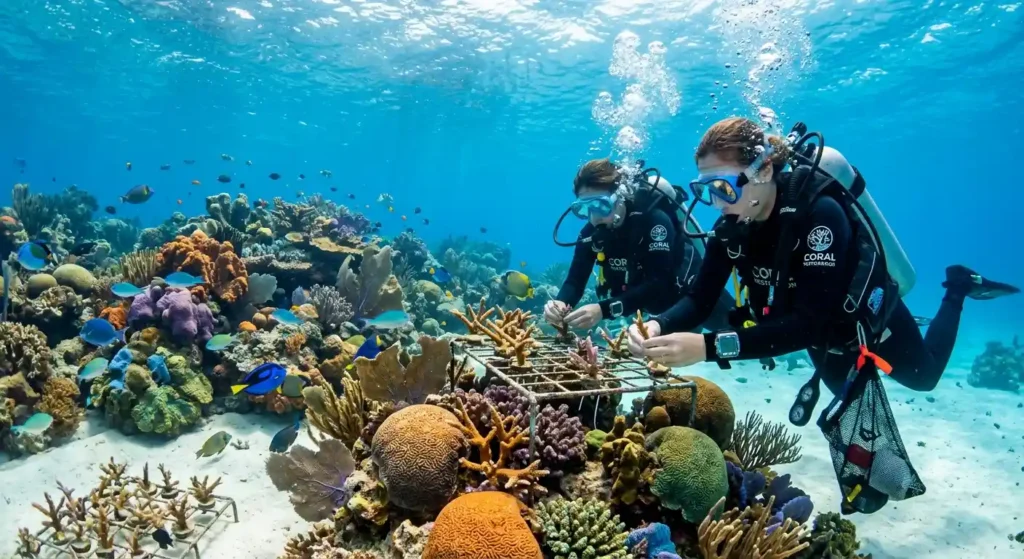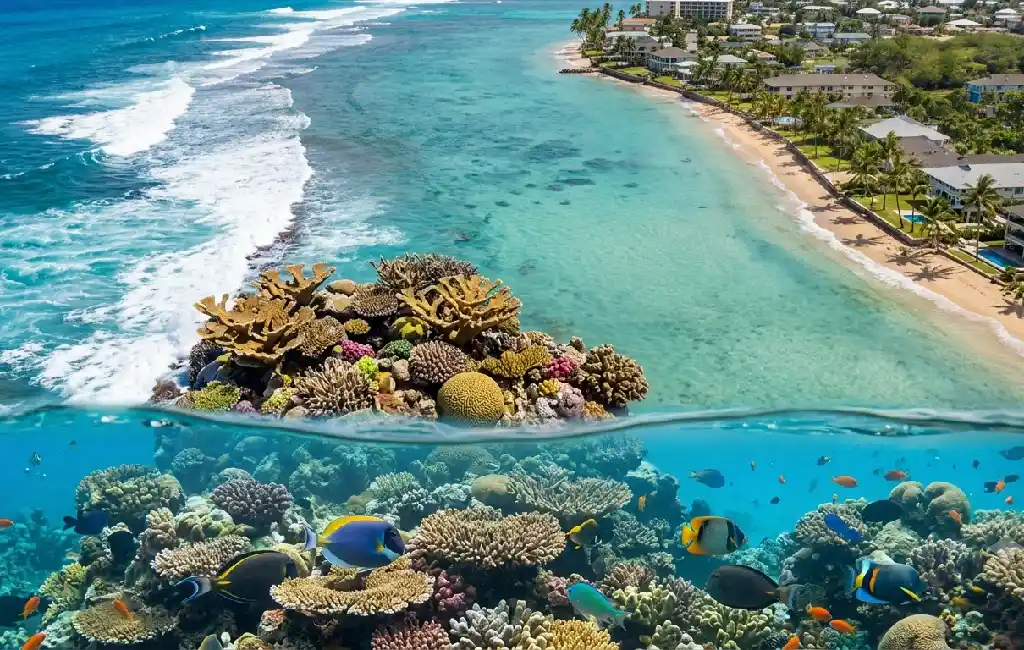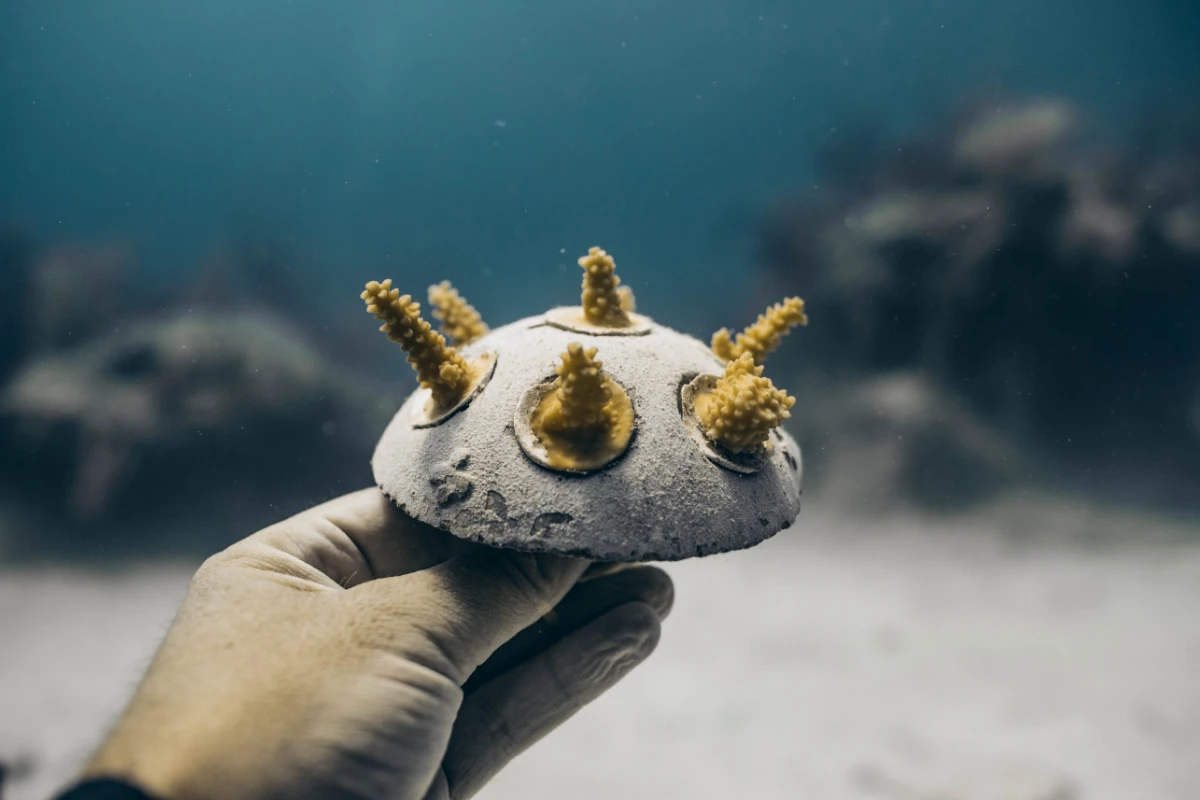
An artificial reef is a “manmade structure that may mimic some of the characteristics of a natural reef,” in NOAA’s words.1 It gives fish and other marine life a hard surface and places to hide, but it does not add living coral. That limit matters more than anything else in this article. A structure and a living reef do different jobs, and a coastal owner, port or resort deciding what to fund should know which one it is buying.
The Short Version
- NOAA defines an artificial reef as a manmade structure that may mimic some characteristics of a natural reef. It adds structure, not living coral.
- A 2020 analysis of 39 studies found that artificial reefs can support fish density, biomass, species richness and diversity comparable to natural reefs, though results varied by ocean basin, latitude and material.
- Materials and anchoring decide outcomes. Osborne Reef off Fort Lauderdale, built from up to two million tires, is still the standard cautionary case.
- A structure breaks up waves and shelters fish on day one. Living coral builds and repairs reef over time. A hybrid reef uses both.
- Before funding any reef structure, ask what it is for, where it sits, what it is made of, who will monitor it, and whether living coral is part of the plan.
An artificial reef is a manmade structure, and today it is usually concrete, steel or limestone
NOAA’s list of artificial reef materials has changed over the decades. Rocks, cinder blocks, wood and old tires were used historically, and limestone, steel and concrete are common now. The structures include shipwrecks, oil and gas platforms, bridges and lighthouses that were never built to be reefs but ended up serving as habitat.¹
Purpose-built concrete modules are the other big category. The Reef Ball Foundation, which makes one widely used type, describes a Reef Ball as “a designed artificial reef module which mimics the structure and function of a natural reef,” made with concrete that has a pH similar to seawater and with hollow interior spaces that give marine species shelter.2 That is the maker’s description. I read it as a design goal and not as a measured result.
The United States has a formal view of why anyone builds these. The National Artificial Reef Plan, as amended in February 2007, lists five purposes: recreational diving, social and economic benefits for coastal communities, more habitat to reduce pressure on nearby natural reefs, fewer conflicts between user groups, and mitigation or restoration for habitat lost to commercial activity.3 The last one overlaps with the mitigation work that ports and developers face, which is a different job from building a fishing reef.
Do artificial reefs work? What the fish data show
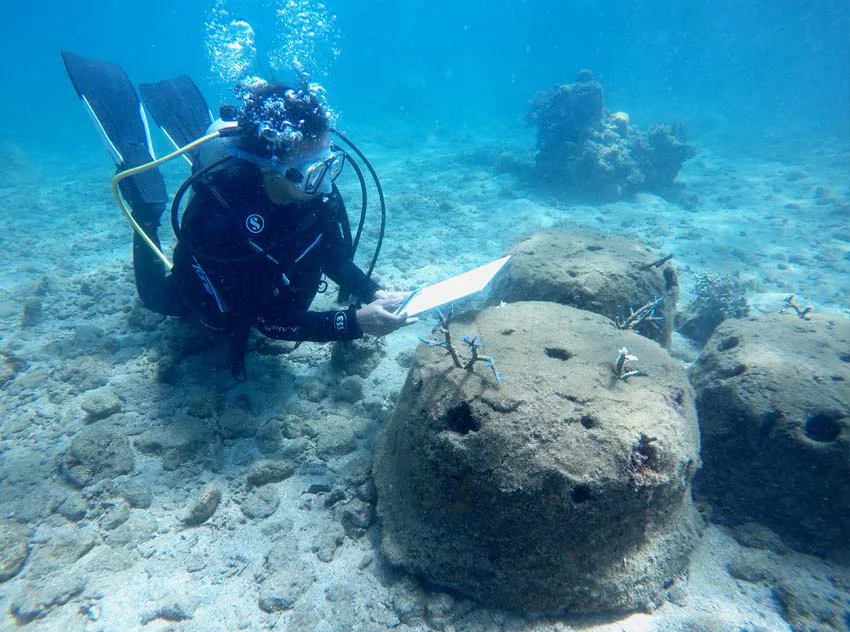
A 2020 meta-analysis of 39 studies by Paxton and colleagues, published in Frontiers in Marine Science, found that artificial reefs “support comparable levels of fish density, biomass, species richness, and diversity” to natural reefs.4 The size of the effect varied with ocean basin, latitude and material. North Carolina Sea Grant’s summary of the paper reports that reefs in the Atlantic, or made of concrete, held higher fish densities than the natural reefs they were compared with.5 The authors’ own conclusion is that artificial reefs are “not one-size-fits-all” and need site-specific assessment.
I would add two cautions. A fish count does not tell you whether a structure creates new fish or only gathers fish that already lived nearby, and the abstract does not settle that question. I would not claim it for any project. Fish are also not coral. A reef structure that attracts fish has made a good fishing spot, and it has not restored a coral reef.
When artificial reefs fail: the Osborne tire reef off Fort Lauderdale
NOAA lists old tires among the materials used historically. Osborne Reef shows what can happen when they are used at scale. In the 1970s, up to two million tires bundled with metal clips were placed over about 35 acres off Fort Lauderdale. The clips rusted, the bundles came apart, and storms and currents have dragged tires across the living reef nearby, CBS News reported in 2015.6
I would rather use this example than a success story, because it shows where a well-meant project goes wrong. The problem was the material and the way it was held together. For a buyer, that means the choice of material, how it is anchored, and how close it sits to living reef are not details to leave to a contractor. Ask who is responsible for the structure in year 20, and what happens to it in a hurricane.
Artificial reef, restored reef or hybrid reef: what each one does
Three things get called a reef project, and they are not interchangeable.
| Artificial reef | Restored reef | Hybrid reef | |
| What you add | A built structure: concrete modules, steel, limestone or a ship | Living coral planted on a degraded natural reef | A built structure with living coral added to it |
| What it does on day one | Hard surface and shelter for fish, and in some designs less wave energy | Little, because coral takes time to grow | Shelter and surface from the structure, with coral starting to grow |
| Living coral | Only if it settles on its own | Yes | Yes, if corals are added |
| Repairs itself | No. It is maintained or replaced | Can, if conditions allow | The coral can. The structure cannot |
| Typical use | Fishing, diving, fish habitat, wave reduction | Recovering a reef that has lost coral | Coastal protection where reef has been lost |
A structure does its work immediately. It breaks up waves, gives fish somewhere to hide and gives divers and anglers a destination. It cannot grow, and it cannot repair itself after a storm. Living coral works the other way around. It starts small, takes time, and can die in a heat wave, but a healthy reef builds more reef, a process we explain in our piece on how coral reefs are formed. Our guide to coral reef restoration covers that side, and corals can also be planted on a structure, which our piece on coral transplantation explains in terms of how they are attached.
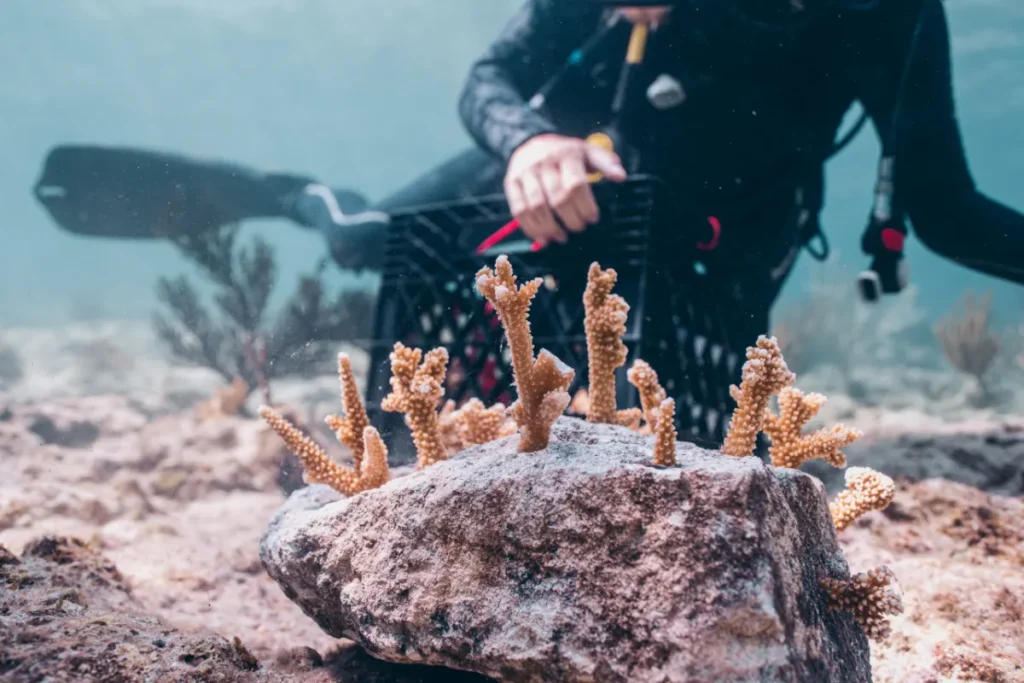
Here is where Coral Vita sits. We grow corals. We do not manufacture reef modules, and I would not claim we do. A hybrid project needs both parts, and the coral has to come from somewhere. We have grown more than 100,000 corals across 52 species at our land-based farms, and I think the honest framing is that structure and living coral are partners in a project, not competitors for the same budget. How the pieces fit depends on the site, so I would start with the goal and work backward.
Hybrid reefs and artificial coral reefs for coastal protection: Reefense and DUBAI REEF
Coastal protection is where hybrid designs are getting the most attention, and two projects show the range.
DARPA’s Reefense program funded three teams: Rutgers University, working with oyster reefs on the Gulf Coast; the University of Hawaii, working with coral in the Pacific; and the University of Miami, working with coral at a test site in Biscayne National Park. The program asked for at least 70 percent wave energy reduction from each structure, with 90 percent as the aim.7 Coral Vita was not one of the three teams.
The only measured result I found is from Rutgers. At Tyndall Air Force Base in Florida, the team installed porous concrete modules and recycled oyster shell between October 2024 and March 2025. In April 2026 it reported that the hybrid reef “reduced wave power by more than 90% in tests,” with the paper in PNAS.8 That result is for an oyster reef. I did not find a measured result for either of the two coral teams, so I would not extend the 90 percent figure to coral. Our piece on living shorelines covers the oyster and mangrove side of this idea in more detail, and what a protected coast is worth in dollars is in our guide to coral reef coastal protection.
DUBAI REEF is the largest planned project in the region where we work. It was announced at COP28 in December 2023. Phase one launched on 23 November 2024 with 1,000 modules fabricated, out of 20,000 to be deployed over three years across a 600 square kilometer study area. The Dubai Media Office calls it “the world’s largest single purpose-built reef development,” which is its own description.9 I am citing it as a public example of scale. It is not a Coral Vita project, and nothing here should be read as describing our work. [VERIFY: Sam to confirm Coral Vita has no role in DUBAI REEF before publishing this sentence.]
Ships as reefs: the Black Pearl and the SS United States
Some of the biggest searches in this topic are about ships. The Black Pearl, a 97-foot steel-hulled pirate-themed vessel, joined Panama City Beach’s artificial reef program, according to the destination’s own announcement in December 2025.10
The SS United States went further. The 990-foot ocean liner was deliberately sunk on 11 November 2026 about 25 miles southwest of Destin, Florida, in about 180 feet of water, with its top deck roughly 60 feet below the surface. The Associated Press described it as the world’s largest artificial reef, ahead of the USS Oriskany, sunk in 2006.11 It was part of a $10.1 million Okaloosa County plan.12 A ship is an artificial reef in NOAA’s sense: it is a structure, and the fish and corals that settle on it will decide over time whether it behaves like a reef.
What a coastal owner should ask before funding a reef structure
If you own a resort, a port, a marina or a stretch of shoreline and someone is proposing a reef structure, five questions will tell you most of what you need to know.
- What is it for? A fishing and diving site, a wave break, habitat, and mitigation for a development are different goals with different success tests.
- Where does it sit, and how far is it from living reef? Osborne Reef is the reminder that a structure can damage what is next to it.
- What is it made of, and how is it held together? Ask for the material, the anchoring method and the storm rating in writing.
- Who monitors it, for how long, and who pays when it moves or breaks? A reef without a monitoring plan is a hope and not a project.
- Is living coral part of the plan, and where will it come from? If the answer is no, say so, and do not call the result a restored reef.
Coral Vita provides reef restoration and mitigation services, described on our services page. If you are weighing a structure against living coral, or planning a hybrid, send us the goal and the site. I would rather help you pick the right design than the bigger contract, and the first conversation is free.
About Coral Vita
Coral Vita is a mission-driven company dedicated to restoring our world’s dying and damaged reefs. Using innovative land-based farming techniques, Coral Vita grows diverse and resilient corals in months instead of the decades they take in nature. These corals are then transplanted into threatened reefs, helping to preserve ocean biodiversity while protecting coastal communities that depend on healthy reefs for protection, food, and income.
Founded by environmental entrepreneurs Sam Teicher and Gator Halpern, Coral Vita’s high-tech coral farms incorporate breakthrough methods to restore reefs in the most effective way possible. In 2021, the company was recognized as the inaugural winner of Prince William’s Revive Our Oceans Earthshot Prize Winner for their pioneering work in coral restoration.
To learn more about Coral Vita’s work or to get involved in coral reef conservation efforts, visit their website at www.coralvita.co or contact them directly through their Contact Us page.
Frequently asked questions
What is an artificial reef?
An artificial reef is a manmade structure that may mimic some characteristics of a natural reef, according to NOAA. It can be a purpose-built concrete module, a shipwreck, a platform or other material placed on the seabed.
What are artificial reefs made of?
Today they are usually concrete, steel or limestone, and sometimes ships or retired platforms. Rocks, cinder blocks, wood and old tires were used historically. Tire reefs have caused problems where the bundles broke apart.
Do artificial reefs help the environment?
They can. A 2020 analysis of 39 studies found fish density and diversity comparable to natural reefs, though results vary by material and site. They do not add living coral unless corals are added.
What is the largest artificial reef in the world?
The Associated Press described the SS United States, sunk off Florida’s Panhandle on 11 November 2026, as the world’s largest artificial reef. The ship is 990 feet long and sits in about 180 feet of water.
References
- https://oceanservice.noaa.gov/facts/artificial-reef.html ↩︎
- https://reefballfoundation.org/reef-ball-description/ ↩︎
- https://media.fisheries.noaa.gov/dam-migration/noaa_artificial_reef_guidelines.pdf ↩︎
- https://doaj.org/article/99edfa1a1d5b44f68ba7af01aaa2f100 ↩︎
- https://ncseagrant.ncsu.edu/hooklinescience/do-artificial-reefs-enhance-fish-habitats/ ↩︎
- https://www.cbsnews.com/news/thousands-of-tires-dumped-in-florida-waters-wrecking-coral-reef ↩︎
- https://www.fox35orlando.com/news/artificial-reef-experiments-aim-to-protect-coastal-military-bases-from-hurricanes-massive-waves-erosion ↩︎
- https://www.rutgers.edu/news/coastal-defense-becomes-stronger-showing-early-success ↩︎
- https://mediaoffice.ae/en/news/2024/november/23-11/mansoor-bin-mohammed-witnesses-landmark-launch-of-dubai-reef-deployment-phase ↩︎
- https://www.visitpanamacitybeach.com/articles/post/pirate-ship-black-pearl-joins-visit-pcbs-artificial-reef-program/ ↩︎
- https://www.wlox.com/2026/11/11/live-ocean-liner-sinks-off-coast-florida-panhandle-make-largest-artificial-reef/ ↩︎
- https://www.cbsnews.com/philadelphia/news/ss-united-states-artificial-reef-2026-florida/ ↩︎