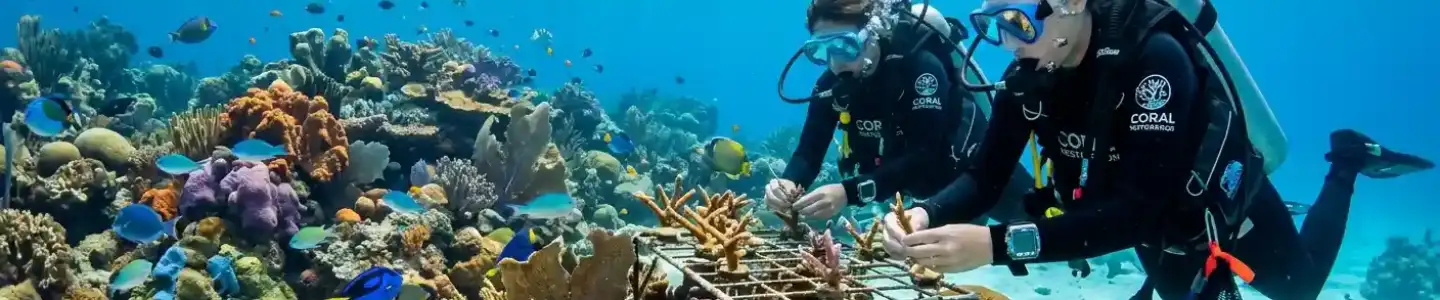
Coral transplantation means moving living coral from one place to another and attaching it to a reef so it keeps growing. The term covers two different jobs. Outplanting grows coral fragments in a nursery and plants them on a degraded reef to restore it. Relocation moves existing coral colonies out of the way of a construction project or another planned disturbance so they survive. The attachment skills overlap, but the goals, timelines, buyers and measures of success are different, and mixing them up is how projects end up judged against the wrong yardstick.
The Short Version
- Coral transplantation has two uses: outplanting for reef restoration, and relocation for mitigation when a project would otherwise destroy the coral.
- A 2020 review of coral restoration projects found reported survival between 60 and 70 percent, but most projects were monitored for under 18 months.
- In a Virgin Islands study of elkhorn coral, cable ties, epoxy and cement gave similar survival, so the choice of fixing is mostly a cost and labor decision.
- Relocation can work well over short distances. In a 2024 Queensland study, 94.6 percent of moved corals were alive after 12 months and 77.5 percent after two years.
- Transplanting corals does not remove the cause of reef decline. Heat, pollution and poor land management still decide whether a reef recovers.
Coral transplantation covers two jobs: outplanting for restoration and relocation for mitigation
People use “coral transplantation” for both, and search results blend them. The difference is where the coral comes from and why it moves.
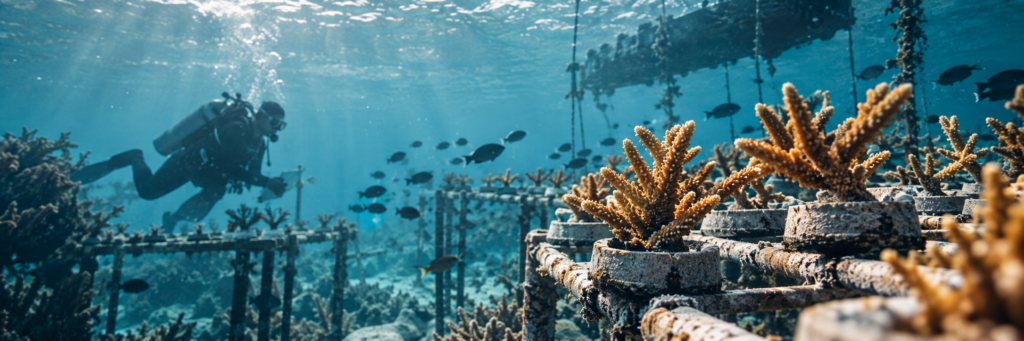
Outplanting is restoration. A reef has lost coral to bleaching, disease, storms or damage, and the aim is more living coral on that reef. Many outplants start as small fragments grown in a nursery, either in the ocean or in tanks on land. When they are large enough, they are carried to the reef and attached to bare rock. Success is measured in survival, growth, coral cover and, over time, whether the reef supports fish and other animals again. Our guide to coral reef restoration covers the wider picture of how this fits with other restoration methods.
Relocation is mitigation. The reef is intact, but a port, pipeline, channel or seawall will destroy part of it. Colonies are detached, moved to a safer nearby site and reattached before work begins. The aim is to keep the coral alive that would otherwise be lost, and the work is usually driven by a permit, a planning condition or a lender’s environmental standard rather than by a restoration budget. Success is measured by how many of the moved colonies are still alive months and years later.
I will use “outplanting” and “relocation” for the rest of this piece. If you came here to fund reef recovery, the sections on outplanting, survival and genetic diversity matter most. If you came because a coastal project may disturb a reef, skip to the sections on relocation and on which job you need.
Outplanting moves nursery-grown corals onto a degraded reef in five steps
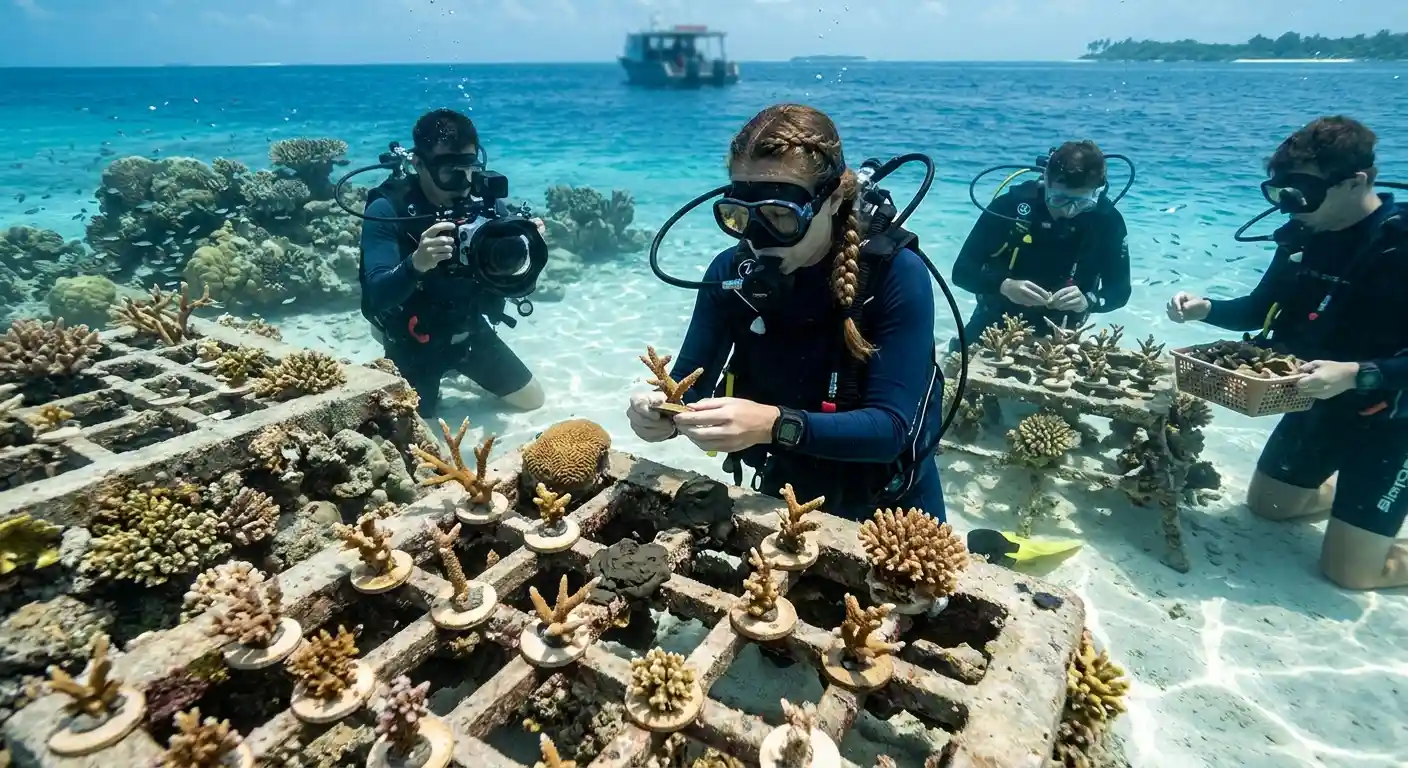
Every outplanting project follows the same rough order, whether it is run by a university, a nonprofit or a company. First, someone chooses source colonies and collects fragments. Second, the fragments are grown in a nursery until they are big enough to survive on the reef. Third, a restoration site is chosen and prepared. Fourth, the corals are attached to the reef. Fifth, the site is monitored.
The first four steps are the part people picture. The fifth step is where projects differ most. A transplanted coral that is alive on the day it is attached tells you very little. What matters is whether it is alive and growing after a storm season and a hot summer.
The scale of the field is easy to underestimate. A 2020 systematic review of coral restoration found eight main methods in use, covering 229 coral species from 72 genera.1 That is a large body of practice, and it is still uneven. The review noted that fast-growing branching corals were the focus of 59 percent of studies, that the median restored area was only 100 square meters, and that 60 percent of projects reported less than 18 months of monitoring. Those numbers matter for anyone reading survival claims. A project can report high survival after a year and still be too young to say anything about long-term recovery.
Coral fragments come from fragmentation, spawning and land-based farms
A coral colony is a group of connected polyps that build a skeleton of calcium carbonate. Most reef-building corals are scleractinian, or stony, corals. Because a colony is made of many genetically identical polyps, a piece can be broken or cut off and grow into a new colony. That is the basis of fragmentation, the most common way to produce corals for outplanting.
There are three common sources of material.
Fragments of opportunity are pieces already broken off by storms or boat strikes. They are the cheapest source, and rescuing them before they die is one of the oldest transplantation practices.
Cut fragments are taken from donor colonies on purpose and grown in a nursery. For branching corals, a fragment a few centimeters long can regrow into a full colony. For slow-growing massive corals, which are the brain, boulder and star corals that build much of a reef’s bulk, a technique called microfragmentation cuts the coral into very small pieces that are then placed close together so they fuse. The method is credited to David Vaughan at Mote Marine Laboratory. Microfragments of the same genotype grow together into one larger colony, which makes massive corals usable in restoration at all.2
Sexually produced corals start as eggs and sperm collected during a mass spawning event. The larvae are raised in tanks and settle on small tiles or plugs. This route builds genetic diversity into the stock, because every larva is genetically new, and it is one reason spawning and larval rearing are growing parts of the field. It is also harder to run, since it depends on a short natural spawning window each year.
Where the corals are grown also matters. Ocean nurseries hold fragments on frames or lines in the sea. They cost less to set up, but they sit in the same water as the reef, so a marine heat wave or a storm can hit the nursery and the reef at once. Land-based farms hold corals in tanks and raceways where temperature, light, water chemistry and feeding are controlled. They cost more to run, but they protect stock from storms, predators and disease, can produce coral all year, and let a team test how different genotypes handle heat before anything is planted. This is the model Coral Vita uses. We have grown more than 100,000 corals across 52 species at our farms, and we are active in The Bahamas, Saudi Arabia and the United Arab Emirates. Our experience is one example of the land-based approach, not a substitute for the independent data in this article. You can read more about our methods on our pages about coral gardening and coral fragmentation.
Attachment methods perform about equally well, so choose by cost and conditions
Once corals reach the reef, they have to be fixed in place so waves and currents do not wash them off. Marine epoxy, cement or hydraulic cement, plastic cable ties, nails, clips and drilled pegs are all used. Which one to pick is a common question, and one of the clearest answers comes from the U.S. Virgin Islands.
Researchers there studied elkhorn coral, Acropora palmata, a threatened species. They moved fragments from a donor site to nearby restoration sites and compared plastic cable ties, two types of epoxy and hydrostatic cement. Survival was similar across all the attachment methods. The fragments left loose at the donor site did worse than the ones attached to the reef: they died faster and grew slower. Transplanted fragments died at about the same rate as fragments that stayed at the donor site, which is a useful result for anyone worried that moving a coral harms it. Clearing algae from the attachment spot improved growth, and after four years the transplanted fragments had grown to an average area of 1,450 square centimeters.3
The practical lesson is that the choice of glue or tie looks like a cost and labor decision more than a biological one. What did matter in that study was whether a fragment was attached to the reef at all, and whether algae was cleared from the spot. Cable ties are quick and cheap but leave plastic on the reef that has to be monitored or removed.
Site selection and environmental factors decide whether transplanted corals survive
A coral needs a stable, suitable substrate, enough light, water movement and clean water. Site selection is the step where those conditions get checked, and it is where many failed projects went wrong.
Three questions come first. Is the bottom stable? Corals attached to loose rubble or shifting sand tend to be buried or rolled. Loose rubble from dead coral skeletons is a poor surface, and solid reef rock is a better one. Is the water clean and well flushed? Sediment, nutrients and wastewater stress corals and encourage algae that overgrow them. And what killed the coral that was there before? If the cause is still present, planting more coral is unlikely to help.
A study in the Gulf of Eilat, in the northern Red Sea, shows what a hard site looks like. Researchers planted “Reef Carpets” of nursery-grown branching corals on a sandy seabed at depths of about 11 to 13 meters, in three plots of roughly 8 square meters each. After 17 months, survival ranged from 65.3 percent for Acropora cf. variabilis to 54.6 percent for Pocillopora damicornis and 48.7 percent for Stylophora pistillata.4 Median colony lifespan was 11 to 17 months, and almost all colonies had lost some tissue to sediment that shifted across the plots. The authors designed the plots for biodiversity rather than only for coral survival, and I will return to what they found. The survival numbers are a fair picture of what planting on sand does: it works for a while, and it is harder than planting on rock.
A relocation study in Hawaii makes the same point from the other direction. Researchers who reviewed a coral relocation in Kāne’ohe Bay concluded that the method should be limited to reef areas that are not exposed to storm surf or continuing human pressure, and that it works best when donor and receiving sites are close and similar. They also warned that restoration on reefs with ongoing poor land management or severe bleaching may be futile.5 I agree with that. A transplant fixes a symptom. It does not fix the stressor.
Survival data show a wide range, so read the monitoring period before the percentage
Across published projects, reported survival sits between 60 and 70 percent, according to the 2020 review.¹ Individual projects range far above and below that, depending on species, site, season and how long anyone looked.
The Virgin Islands and Red Sea studies above show two ends of that range: attached elkhorn fragments that grew for four years, and branching colonies on sand where survival at 17 months was about half or lower for two of three species. A 2020 comparison of four long-running programs found a more encouraging pattern at the reef level. Researchers surveyed restored and unrestored sites in Thailand, the Maldives, the Florida Keys and St. Croix. Hard coral cover was about twice as high at restored sites as at unrestored sites in three of the four locations, and reef structure was more complex at restored sites in all four. The authors also cautioned that these were snapshot surveys, and that coral health was poorer at restored sites in the Florida Keys and St. Croix. They flagged a related risk as well: restoration focused on one genus, Acropora, may not give long-term resilience.6
If you are reading a proposal or a case study, three questions help. How long was it monitored? What was the survival of colonies after the first heat season, not just the first month? And what was the comparison, an unrestored reef, an unattached control, or nothing? The honest answer for the field today is that transplanted coral can survive and can raise coral cover and structure at the scale of a site, but long-term recovery of a whole reef has been shown in far fewer cases.
Transplanted corals can bring fish, invertebrates and higher species diversity back to a reef
The reason to put coral back is not the coral alone. It is the reef associated communities that live in and around it: fish, crabs, snails, worms, sponges and thousands of smaller organisms that use the structure for food and shelter.
Evidence on this is still thinner than evidence on coral survival, but it exists. In the Red Sea Reef Carpets study, the transplanted plots attracted new coral recruits, with 137, 111 and 73 recruits counted across the three plots at one, three and five months. Transplanted Stylophora pistillata colonies released about 4.6 larvae each, compared with 1.6 for natural colonies nearby, which suggests the planted corals were reproducing. The paper also reported on the animals living on and around the colonies, with counts of 66 fish taxa and 123 invertebrate taxa. The authors reported a mean of 76 fish species on live Acropora colonies, which is a measure of the diversity those colonies held, not an increase attributable to the transplant.
A second line of evidence comes from Hawaii. After corals were moved from a shipping channel in Kāne’ohe Bay to a nearby patch reef, fish abundance at the relocation site rose from 8 in 2005 to 384 in 2016, and fish species richness rose from 1 to 12. Herbivores made up more than 80 percent of the fish in 2016. That is encouraging, but it is a single site, and fish counts followed the place that got more structure, not a controlled experiment.
The 2020 comparison of restored reefs found that reef structure was more complex at restored sites in all four locations. That matters because fish and invertebrates respond to structure. More holes and branches mean more places to hide and feed. The same study found that juvenile corals and genus richness rose only at one site, Koh Tao in Thailand, so taxonomic richness did not always follow. Restoration can add structure faster than it adds species.
Genetic diversity and coral microbes are the next constraint on transplantation
Corals grown from fragments are clones of their donor. A single donor colony can supply many fragments, and if a project plants only a few genotypes, the reef ends up with a small set of genetically identical corals. Genetic diversity is a concern for two reasons. A uniform population can all be vulnerable to the same disease or heat event. And moving corals between locations can mix local gene pools in ways that are not always helpful.
A guide to restoration genetics from 2008 listed risks of moving coral material, including founder effects, genetic swamping, inbreeding and outbreeding depression, while noting that direct evidence in reef-building corals was limited. It argued that genetic tools can help choose where propagules should come from.7 Good programs collect from many donor colonies, track genotypes, and mix them at the outplant site. Our approach at Coral Vita includes selecting donor colonies from multiple genetic lines and testing stock under heat and other stress so that we can identify tolerant genotypes. Those results are company-reported.
Coral microbes are a newer area. Corals host communities of bacteria, and some researchers think the right microbes can help corals cope with stress. A 2019 study applied a mix of native bacteria to corals in aquarium experiments at 26 and 30 degrees Celsius with a pathogen challenge, and found that it partly reduced bleaching. The work was done in controlled tanks, and the paper did not report field testing.8 I would treat claims that transplanting beneficial microbes raises survival in the ocean as early-stage until field trials back them up.
Bleaching and climate risk limit what transplantation can promise
Transplantation addresses the loss of coral. It does not address climate change, which is the main cause of mass coral bleaching, or ocean acidification, which makes it harder for corals to build calcium carbonate skeletons.
The 2023 marine heat wave in Florida showed the limits clearly. A buoy at Manatee Bay recorded water at 101.1 degrees Fahrenheit in July, and the Coral Restoration Foundation lost more than half its nursery stock, falling from about 50,000 corals to about 20,000.9 Fewer than 22 percent of staghorn corals at surveyed sites were still alive, and the organization moved remaining stock to land-based facilities in Sarasota and Palm Beach and paused most outplanting in 2024. NOAA Fisheries reports that heat waves in 2023 and 2024 killed 89 to 100 percent of known wild and restored elkhorn colonies in the Florida Keys. Elkhorn coral is listed as threatened under the Endangered Species Act, has declined by 97 percent since the 1980s because of white band disease, and now makes up less than 3 percent of its former abundance.10
Two things follow. One is that nurseries need a plan for heat. Land-based systems are one response to events like this: stock held on land can be kept alive when the ocean gets too warm to plant into, and can be selected for tolerance. The other is that outplanting should be timed and sited with heat in mind, and should be seen as part of a package that includes cutting local pollution, protecting reefs from damage and reducing emissions. Our pieces on coral bleaching and ocean acidification cover those pressures in more detail.
Coral relocation moves colonies out of a project’s path, and the results depend on distance and size
Relocation is the version of transplantation that most often meets a deadline and a regulator. The question is not whether to restore a reef but whether the corals in the way of a build can be kept alive. Four cases give a sense of what is realistic.
At Hayman Island, Queensland, a 170 meter wastewater pipeline was built in 2020. Reef Ecologic detached 204 corals, moved them between 20 and 100 meters, and attached them to bare rock with a concrete mix. Survival was 94.6 percent at 12 months and 77.5 percent at two years. Smaller corals survived better, and the authors compared the results with a global average relocated-coral survival of 64 percent.11
For the Tuas Port development in Singapore, about 2,300 of roughly 2,800 hard coral colonies at Sultan Shoal were relocated between September 2013 and August 2014 to sites at St. John’s Island and the Sisters’ Islands Marine Park. Colonies were attached with epoxy and monitored for five years. The project page does not give a survival figure, so I will not offer one.12
Near Kingston Harbour in Jamaica, at Rackham’s Cay, about 60,000 organisms, including corals, gorgonians, sea urchins and seagrass, were moved between December 2001 and February 2002 at a cost of about US$1.7 million. Coral cover in the relocation area rose from 15 to 20 percent. The authors called transplanting slow, technically difficult and expensive, but potentially useful for reconciling development with ecology, and noted that the moved organisms were not unique or endemic.13
In Kāne’ohe Bay, Hawaii, about 68,000 kilograms of finger coral and rice coral, covering roughly 200 square meters, were moved by volunteer divers from a shipping channel to a nearby patch reef between 2004 and 2005. The authors reported no survival rate for the move and offered the cautions on site conditions described above.
Across the four cases a pattern shows up. Short moves of small colonies to similar nearby habitat do well. Large, old or rare colonies are harder, projects with long monitoring are more informative, and relocation works best as one tool in a mitigation plan that also tries to avoid and reduce harm in the first place. It does not turn a destructive project into a harmless one, and the people who run the best projects say so. Permit rules and approved methods differ by country, so any developer should confirm requirements with the relevant marine authority before planning.
Which job do you need: restoring a reef or moving coral out of a project’s way?
Most buyers know which side they are on, but it helps to say it plainly.
If you want to put coral back on a degraded reef, because it is a reef near your coastal property, a reef your community or customers depend on, or part of a conservation commitment, you are buying outplanting. The questions to ask are about source stock, genetic diversity, the nursery’s heat plan, the site, and how long monitoring runs. Our page on corporate funding for reef restoration explains how companies fund this work, and the wider link between reef health and coastal value is covered in our piece on coastal adaptation.
If a port, pipeline, channel, resort or other project will disturb coral, you are looking at relocation or a mitigation package. The questions to ask are about survey and permitting, method, how far corals will be moved, the monitoring period, and what the plan is if survival falls below the agreed threshold. If your project is in the UK, biodiversity net gain is a separate planning requirement, and a coral move does not satisfy it by itself.
Coral Vita provides restoration and mitigation services, described on our services page. I would rather a client pick the right job than the bigger contract, so if you are unsure which applies, that is a good first conversation to have.
About Coral Vita
Coral Vita is a mission-driven company dedicated to restoring our world’s dying and damaged reefs. Using innovative land-based farming techniques, Coral Vita grows diverse and resilient corals in months instead of the decades they take in nature. These corals are then transplanted into threatened reefs, helping to preserve ocean biodiversity while protecting coastal communities that depend on healthy reefs for protection, food, and income.
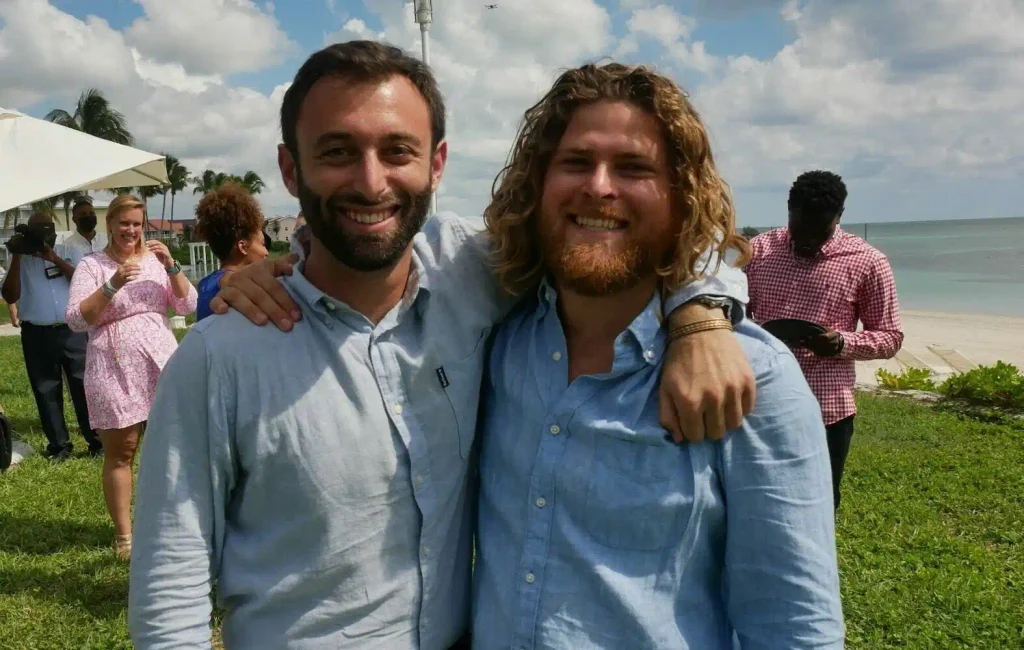
Founded by environmental entrepreneurs Sam Teicher and Gator Halpern, Coral Vita’s high-tech coral farms incorporate breakthrough methods to restore reefs in the most effective way possible. In 2021, the company was recognized as the inaugural winner of Prince William’s Revive Our Oceans Earthshot Prize Winner for their pioneering work in coral restoration.
Frequently asked questions
What is coral transplantation?
Coral transplantation is moving living coral from one place to another and attaching it to a reef. It is used for restoration, when nursery-grown fragments are planted on a degraded reef, and for mitigation, when colonies are moved out of the way of construction.
What is the difference between coral outplanting and coral relocation?
Outplanting plants nursery-grown fragments on a degraded reef to restore it. Relocation moves colonies already living on a reef out of the path of development, such as a port or pipeline, so they are not destroyed. The goals and success measures differ.
How successful is coral transplantation?
A 2020 review reported survival between 60 and 70 percent, though many projects monitored for under 18 months. A 2024 Queensland relocation study found 94.6 percent survival at 12 months and 77.5 percent at two years. Results depend on species, site and heat.
Does coral transplantation fix bleaching?
No. Transplanting replaces coral that has been lost, but it does not remove the heat, pollution or acidification that caused the loss. Nurseries and outplants can also be hit by heat waves, as in Florida in 2023.
References
- https://reefresilience.org/article-summaries/coral-restoration-a-systematic-review-of-current-methods-successes-failures-and-future-directions/ ↩︎
- https://coralvita.co/coral-cafe/coral-fragmentation/ ↩︎
- https://digitalcommons.uri.edu/nrs_facpubs/349 ↩︎
- https://link.springer.com/article/10.1038/s42003-024-05831-4 ↩︎
- https://peerj.com/articles/3346 ↩︎
- https://www.mdpi.com/1424-2818/12/4/153/htm ↩︎
- https://pure.psu.edu/en/publications/a-restoration-genetics-guide-for-coral-reef-conservation/ ↩︎
- https://pure.psu.edu/en/publications/marine-probiotics-increasing-coral-resistance-to-bleaching-throug/ ↩︎
- https://www.scientificamerican.com/article/extreme-summer-heat-threatens-coral-replanting-effort ↩︎
- https://www.fisheries.noaa.gov/species/elkhorn-coral ↩︎
- https://www.jcu.edu.au/news/releases/2024/april/reef-management-techniques-potentially-coral-saving ↩︎
- https://www.dhigroup.com/projects/a-delicate-journey-coral-relocation-supports-sustainable-port-development-in-singapore ↩︎
- https://archivo.revistas.ucr.ac.cr/index.php/rbt/article/view/26625 ↩︎