Dredging removes sediment from the seabed to deepen channels and harbors. Near a coral reef, its main environmental impact is that sediment. It clouds the water, which cuts off the light corals depend on, and it settles on the reef and buries coral. The damage can reach hundreds of meters beyond the channel, and it can be limited by planning, monitoring and, where corals sit in the footprint, moving them before work starts. I wrote this for the people who plan, permit or carry out dredging near reefs, many of whom do it for a living and know ports better than I do.
The Short Version
- NOAA defines dredging as the removal of sediments and debris from the bottom of lakes, rivers, harbors and other water bodies, done because sedimentation gradually fills channels and harbors.
- Dredging harms coral through smothering and burial, shading and tissue death. Tolerance varies widely, from under 10 milligrams of suspended sediment per liter on pristine offshore reefs to over 100 on marginal nearshore reefs, so there is no single safe number.
- A 2019 study estimated that over half a million corals were killed within 0.5 kilometers of the PortMiami channel during dredging from 2013 to 2015. A bleaching event and a disease outbreak overlapped, so the attribution is contested.
- Well-run projects avoid reef where they can, set turbidity limits with stop-work triggers, monitor beyond the expected plume, relocate corals in the footprint and restore reef afterward.
- Coral relocation and restoration fit at two points in a project: before work starts and after it ends.
What is dredging, and why do ports need it?
NOAA’s definition is plain: “Dredging is the removal of sediments and debris from the bottom of lakes, rivers, harbors, and other water bodies.” It is done because sedimentation “gradually fills channels and harbors.”1 Ships need depth, so channels get deepened or kept clear.
Two terms come up in permits. Maintenance dredging keeps an existing channel at its design depth. Capital dredging deepens or widens a channel or builds a new one, and it is the kind most likely to reach reef that has never been disturbed. NOAA also describes environmental dredging, which removes sediment to reduce exposure to contaminants, and notes that sediments near cities and industrial areas are “frequently contaminated.” This guide is about dredging near coral, and I will use “dredging” for channel and harbor work unless I say otherwise.
How dredging harms coral reefs: light, burial and direct removal
The standard review of dredging and corals is a 2012 paper by Erftemeijer, Riegl, Hoeksema and Todd in Marine Pollution Bulletin. It reports that “increased sedimentation can cause smothering and burial of coral polyps, shading, tissue necrosis,” and that turbidity cuts the light that corals’ symbiotic algae need to photosynthesize.2 Those algae live inside coral tissue and supply much of the coral’s energy, so a coral under murky water for long enough is starved as well as dusted.
There are three routes of harm. Corals in the path of the dredge are removed along with the seabed. Corals near the channel are buried when the sediment settles. And corals farther away are shaded by suspended sediment that drifts with the current. The first is easy to map. The other two depend on how much sediment is stirred up, where the tide carries it and how long it stays. Dredging is one of several local stresses on reefs, alongside the others in our overview of threats to coral reefs, and local stress matters because it adds to heat stress that a reef may already be carrying.
How much sediment can corals tolerate? There is no single safe number
The same 2012 review is useful because it shows how wide the range is. Chronic suspended sediment tolerance runs from under 10 milligrams per liter on pristine offshore reefs to over 100 milligrams per liter on marginal nearshore reefs, and some species die after weeks at 30 milligrams per liter. The maximum sedimentation corals tolerate ranges from under 10 to over 400 milligrams per square centimeter per day. Sensitive species tolerate high sedimentation for less than a day, while tolerant species can withstand high turbidity for at least five to six weeks.
The review covers 89 species, which is about 10 percent of reef-building corals, and its conclusion is that limits “will always require site-specific evaluations.” I agree, and it has a practical consequence. A turbidity limit copied from another project is a starting point and not an answer. A reef that has lived in murky nearshore water for centuries is not the same animal as a clear-water offshore reef, and the permit limits should reflect that.
What happened at PortMiami: the best-documented case of dredging coral reefs
The best-documented case is the deepening of PortMiami from 2013 to 2015. A 2019 study by Cunning, Silverstein, Barnes and Baker in Marine Pollution Bulletin estimated that “over half a million corals were killed within 0.5 km of the dredged channel,” that sediment buried 50 to 90 percent of nearby reefs, and that the impacts may have spread across 25 kilometers of Florida’s reef tract.3
A separate 2016 study in PeerJ looked at the same project and found a mean sediment depth of 3.0 centimeters at 200 meters from the channel, against 0.3 centimeters at a reference site, with effects up to 700 meters from the channel. The project’s own monitoring extended only 50 meters. Recent partial mortality near the channel was 44 percent, against 21 percent at reference sites.4 That gap between 50 meters and 700 meters is the most useful lesson in the case. If you only look where you expect the damage, you will only find the damage you expected.
The attribution is contested, and it should be. A bleaching event and a coral disease outbreak overlapped with the dredging. The PeerJ authors discuss this, and the university summary of the 2019 study notes that an earlier monitoring program attributed most losses to disease.5 That university page also discloses that Miami Waterkeeper was in litigation over the planned dredging at Port Everglades, the next port up the coast at Fort Lauderdale, so readers on the industry side may see the study as an advocate’s work. I would present the numbers as one team’s estimates, with attribution, and not as settled fact. They are still the best public numbers we have for what a major channel project did to a reef.
How well-run projects limit dredging damage near coral reefs
The mitigation hierarchy applies here in the order you would expect.
The first step is to avoid. The Erftemeijer review says “it is therefore imperative to minimise the need for dredging coral material” and points to the PIANC guide, “Dredging and port construction around coral reefs,” published in 2010 with UNEP, as best practice.² ⁵ Route and design choices made early do more than any control applied later.
The second is to time the work and limit what is released. Timing windows can keep dredging away from sensitive seasons, such as coral spawning and the hottest weeks. Turbidity limits with early-warning and stop-work levels tie the work to measured water quality. Silt curtains, which are floating barriers with a fabric skirt that hold suspended sediment close to the works, can reduce what escapes, though how well they work depends on current and depth.
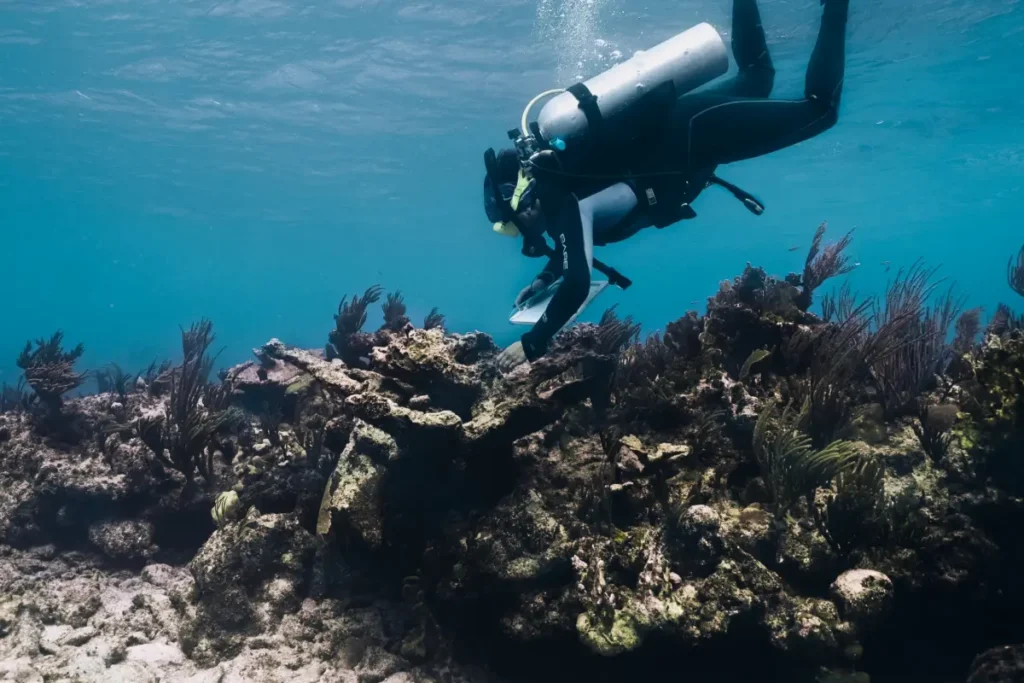
The third is to monitor beyond the expected plume. PortMiami is the argument for that.
The fourth is to move corals out of the footprint before work starts and to restore reef afterward.
One industry case shows how the controls fit together. At a container terminal built in the Dominican Republic in 2002 to 2003, about 2 million cubic meters were dredged. Controls included turbidity limits within 300 meters of the works, with early-warning and action levels tied to baseline values, continuous turbidity stations, monthly dive inspections by an independent auditor, and relocation of 300 healthy elkhorn corals in about a month. The case write-up reports that water quality “never indicated any deterioration” and that there were “no stoppages of the works.”6 The source is an industry consortium describing a project by its members, and it gives no coral cover data, so I would call it a well-documented plan with self-reported results.
Where coral relocation and restoration fit around dredging
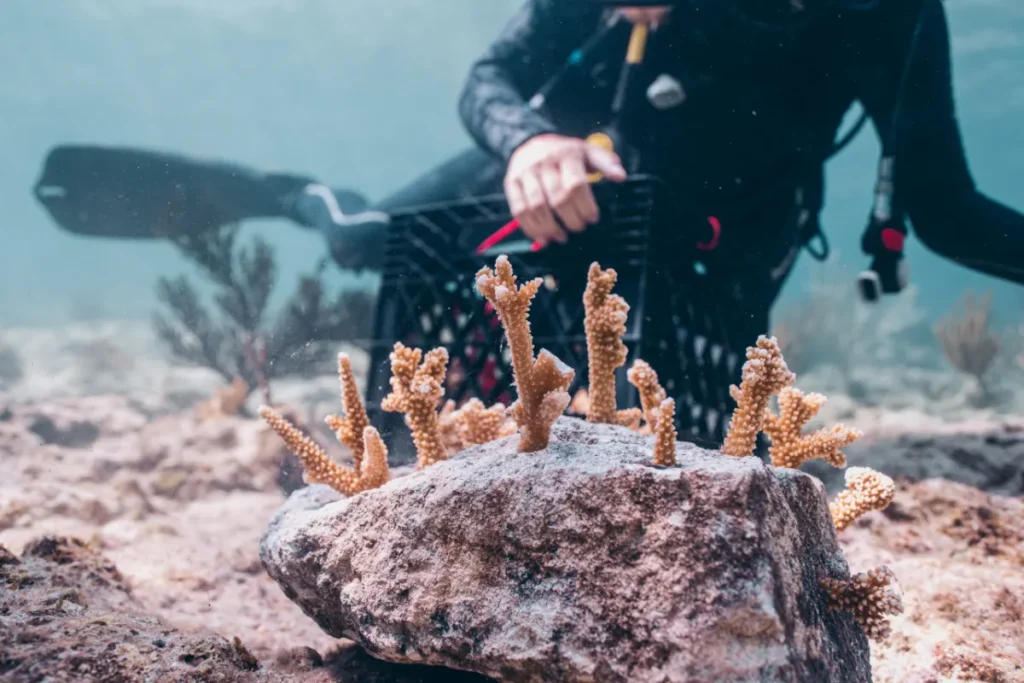
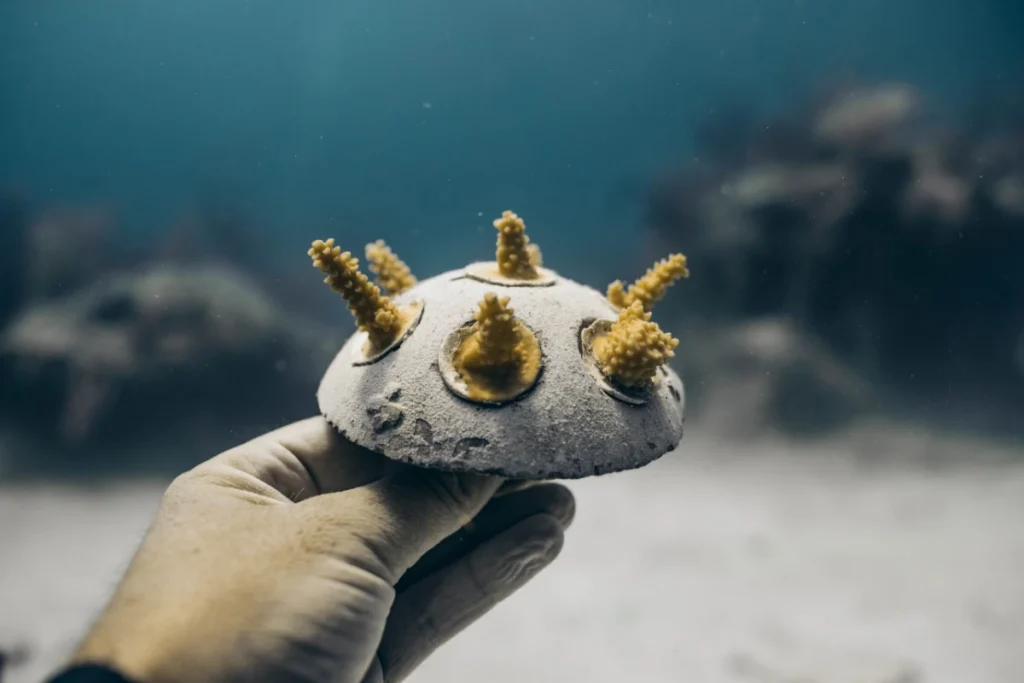
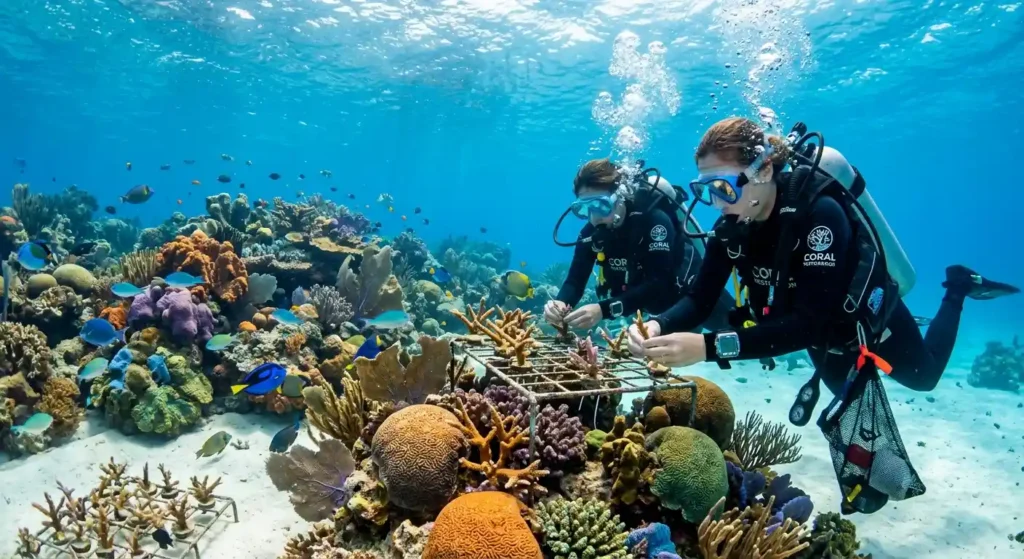
Coral Vita is not a dredging consultant, and we do not set turbidity limits. Our place is at two points in a project: moving corals out of the footprint before work starts, and restoring reef afterward. If a port is being built and corals are in the way, relocating them can help the project get the permits it needs, and some clients then pay for restoration on top.
Relocation in the Gulf is already routine for major ports. In February 2021 Abu Dhabi Ports relocated corals at Khalifa Port under the Environment Agency Abu Dhabi, as one of “a series of mitigation measures to lessen the environmental impact from dredging.”7 How a relocation runs, step by step, and what survival to expect, is in our guide to coral relocation.
Two other connections are worth a look. If your company reports on nature-related risk, dredging is an impact that belongs in the assessment, and our TNFD reporting guide explains where it fits. And if the reef near your channel is part of what protects the coast, the value of that protection is covered in our piece on coral reef coastal protection.
Coral Vita offers coral relocation and restoration services, described on our services page. If you are scoping a channel, port or marine construction project near reef, send us the survey and the schedule, and we will tell you plainly whether relocation is worth planning for.
About Coral Vita
Coral Vita is a mission-driven company dedicated to restoring our world’s dying and damaged reefs. Using innovative land-based farming techniques, Coral Vita grows diverse and resilient corals in months instead of the decades they take in nature. These corals are then transplanted into threatened reefs, helping to preserve ocean biodiversity while protecting coastal communities that depend on healthy reefs for protection, food, and income.
Founded by environmental entrepreneurs Sam Teicher and Gator Halpern, Coral Vita’s high-tech coral farms incorporate breakthrough methods to restore reefs in the most effective way possible. In 2021, the company was recognized as the inaugural winner of Prince William’s Revive Our Oceans Earthshot Prize Winner for their pioneering work in coral restoration.
To learn more about Coral Vita’s work or to get involved in coral reef conservation efforts, visit their website at www.coralvita.co or contact them directly through their Contact Us page.
Frequently asked questions
What is dredging?
Dredging is the removal of sediments and debris from the bottom of lakes, rivers, harbors and other water bodies, according to NOAA. Ports dredge because sedimentation gradually fills channels and harbors, and ships need depth.
Is dredging bad for the environment?
It can be. Near coral reefs, dredging stirs up sediment that clouds the water and buries coral. Impacts depend on the site, the method and the controls. Environmental dredging, by contrast, removes contaminated sediment.
How does dredging affect coral reefs?
Suspended sediment cuts the light corals need, and settling sediment can smother and bury them. At PortMiami, researchers found effects up to 700 meters from the channel, well beyond the 50 meters the project monitored.
Can corals be moved before dredging?
Yes. Corals in the footprint can be detached, moved to a nearby site and reattached before work starts. Survival depends on distance, colony size, site conditions and how long the corals are monitored afterward.
References
- https://oceanservice.noaa.gov/facts/dredging.html ↩︎
- https://core.ac.uk/download/51094378.pdf ↩︎
- https://www.usf.edu/marine-science/news/2019/new-study-finds-over-half-a-million-corals-killed-during-port-of-miami-dredging.aspx ↩︎
- https://peerj.com/articles/2711 ↩︎
- https://wesr-search.unep.org/ckan/dataset/unep-wcmc-rsrc-report-pianc-dredging-and-port-construction-around-coral-reefs ↩︎
- https://www.ecoshape.org/en/cases/coral-protection-puerto-caucedo-dredging-do/ ↩︎
- https://cruise-arabia.com/2021/02/13/abu-dhabi-cruise-terminal-operator-launches-massive-coral-relocation-project/ ↩︎