TNFD reporting means disclosing how your organization depends on nature, how it affects nature, and which risks and opportunities follow, using the 14 recommended disclosures the Taskforce on Nature-related Financial Disclosures published in September 2023.1 It is voluntary. By November 2025, 733 organizations had committed to report in line with it, and the International Sustainability Standards Board (ISSB) has decided to build its own nature-related disclosure work on top of it.2 The practical starting point is the LEAP approach, which walks a company from finding where it touches nature to deciding what to disclose.
Key Takeaways
- TNFD reporting follows 14 recommended disclosures organized under four pillars: governance, strategy, risk and impact management, and metrics and targets.
- The LEAP approach has four phases: Locate, Evaluate, Assess and Prepare.
- The ISSB is targeting October 2026 for an exposure draft of a proposed IFRS Practice Statement on nature-related disclosures, and TNFD plans to stop issuing new guidance after finishing work in progress in the third quarter of 2026.
- GRI 101: Biodiversity 2024 has applied since 1 January 2026, and TNFD says its recommendations are consistent with the GRI Standards to a high extent.
- For coastal and marine businesses, restoration and relocation are two responses a LEAP assessment can lead to. Coral Vita does not perform TNFD assessments.
TNFD reporting follows 14 recommended disclosures under four pillars
The Taskforce on Nature-related Financial Disclosures published its final recommendations on 18 September 2023.¹ The framework contains 14 recommended disclosures arranged under governance, strategy, risk and impact management, and metrics and targets.3 It adds three nature-specific disclosures to the set the Task Force on Climate-related Financial Disclosures (TCFD) used, and it was designed to work with ISSB standards, the Global Reporting Initiative (GRI) standards and the European Sustainability Reporting Standards (ESRS). The TCFD disbanded in October 2023, and the ISSB took over monitoring climate disclosures from 2024.4
I describe the difference between the two as atmosphere versus biosphere: TCFD covered the climate, and TNFD covers the living systems that companies depend on and affect. The framework also supports a government goal. Target 15 of the Kunming-Montreal Global Biodiversity Framework asks large companies and financial institutions to monitor, assess and disclose their biodiversity dependencies, impacts and risks. Financial institutions are a large share of the adopters: of the 733 organizations committed by November 2025, 179 were financial institutions.
The LEAP approach moves from locating your interface with nature to preparing a disclosure
LEAP is TNFD’s method for assessing nature-related issues, set out in its additional guidance on the LEAP approach.5 Locate means finding where your operations and value chain intersect with nature. Evaluate means identifying how you depend on nature and how you affect it at those locations. Assess means working out the nature-related risks and opportunities that follow. Prepare means planning your response and getting ready to report on the issues that are material.
The order matters because disclosure comes last. A company that starts with the report and works backward tends to describe sites it has not assessed. Starting with Locate forces a list of real places, which is also where the work becomes concrete for coastal businesses.
Dependencies and impacts are easiest to see at a coastline
A nature-related dependency is something your business relies on, such as clean water, pollination or a reef that blunts waves before they reach your property. An impact is the effect your activity has on nature, such as dredging near a reef or discharging into a bay. TNFD asks for both, and a LEAP assessment treats them separately because they create different risks.
Coastal real estate, hospitality, maritime logistics, and insurance and reinsurance all have reef exposure that a Locate and Evaluate pass should surface. A 2016 modeling study based on Belize found that nearshore waves were 35 to 50 percent higher with dead coral than with live coral, and several times higher once one meter of sea level rise was added.6 The study used idealized coastlines, so the numbers show direction rather than a forecast for any one site. A hotel or port behind a degraded reef is still exposed to a dependency it may not have recorded. Reef tourism is valued at roughly $36 billion a year in the study Coral Vita’s economic impact page cites, which gives hospitality operators a second dependency to record.7 The TNFD recommendations also ask organizations to describe their human rights policies and how they engage Indigenous Peoples and local communities in assessing nature-related issues [VERIFY: Governance disclosure C wording on tnfd.global].
TNFD, ISSB and GRI are moving closer, and the timeline is changing
The ISSB announced on 7 November 2025 that it will begin standard-setting on nature-related risks and opportunities, drawing on TNFD’s recommendations, metrics, guidance and parts of the LEAP approach. It targeted an exposure draft by the Convention on Biological Diversity’s COP17 in October 2026. By July 2026 the plan had taken the form of an IFRS Practice Statement, which would be voluntary unless a jurisdiction requires it and would build on the TNFD framework.8 [VERIFY: whether the exposure draft has been published by the date this goes live.]
TNFD, for its part, said it would complete work in progress in the third quarter of 2026, pause further technical guidance, and expect to conclude its technical program, likely in 2027.9 GRI 101: Biodiversity 2024, which replaced GRI 304 and builds on the Global Biodiversity Framework, applies to reporting from 1 January 2026.10 GRI and TNFD worked together to align their frameworks, and TNFD says its recommendations are consistent with the GRI Standards to a high extent. The TNFD framework itself remains the reference most companies are using today.
Science based targets for nature turn an assessment into action
TNFD tells a company what to assess and disclose. The Science Based Targets Network (SBTN) covers what to do about it. Its Act step uses the AR3T framework: Avoid and Reduce pressures on nature loss, Regenerate and Restore so that nature can recover, and Transform the underlying systems in which companies are embedded to address the drivers of nature loss.11 I think of TNFD as the what and science based targets as the how. SBTN does not define Regenerate and Restore separately on its Act page, but it ties them to its landscape engagement target, and it gives wetland restoration in a river basin as an example of an activity that can count toward a water target.
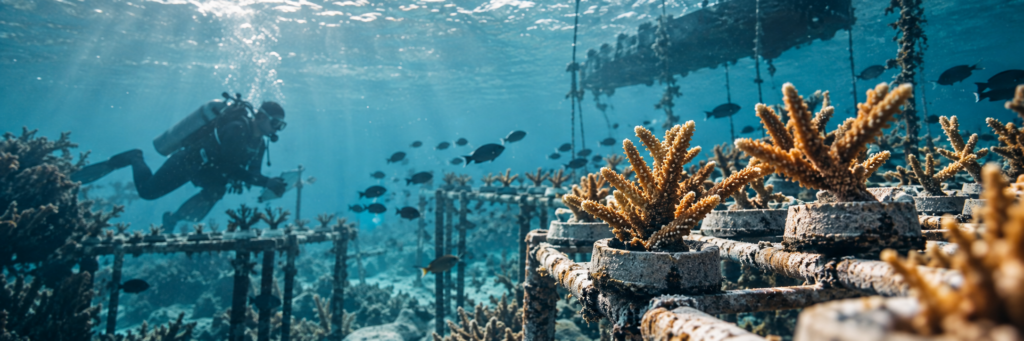
This is where a coastal company’s response options show up. If a Locate and Evaluate pass finds that a port expansion will disturb a reef, relocating the coral before construction is one way to reduce that impact. If it finds that a resort depends on a degraded reef, restoring the reef is one way to rebuild the dependency. Coral Vita provides both, through restoration and mitigation services. We do not perform TNFD assessments or certify alignment with TNFD or SBTN, and a reef project does not replace the assessment.
What to do before your first TNFD report
Start with the sites that touch the coast or ocean. List every owned or operated site and the main suppliers that sit on a shoreline, and mark the ones near a reef, mangrove or seagrass bed. Then run Evaluate on those sites first, recording what each depends on and what each affects. Keep a record of any impact management measures you already use, such as setbacks, construction windows or sediment controls, because the Assess phase asks what mitigation exists before it asks what more is needed. If you want to see how disclosure links to a wider commitment, our explainer on nature positive covers the goal that TNFD reporting supports, and our piece on sustainable finance covers the capital side. For UK projects, biodiversity net gain is a separate planning obligation, not a TNFD requirement.
About Coral Vita
Coral Vita is a mission-driven company dedicated to restoring our world’s dying and damaged reefs. Using innovative land-based farming techniques, Coral Vita grows diverse and resilient corals in months instead of the decades they take in nature. These corals are then transplanted into threatened reefs, helping to preserve ocean biodiversity while protecting coastal communities that depend on healthy reefs for protection, food, and income.
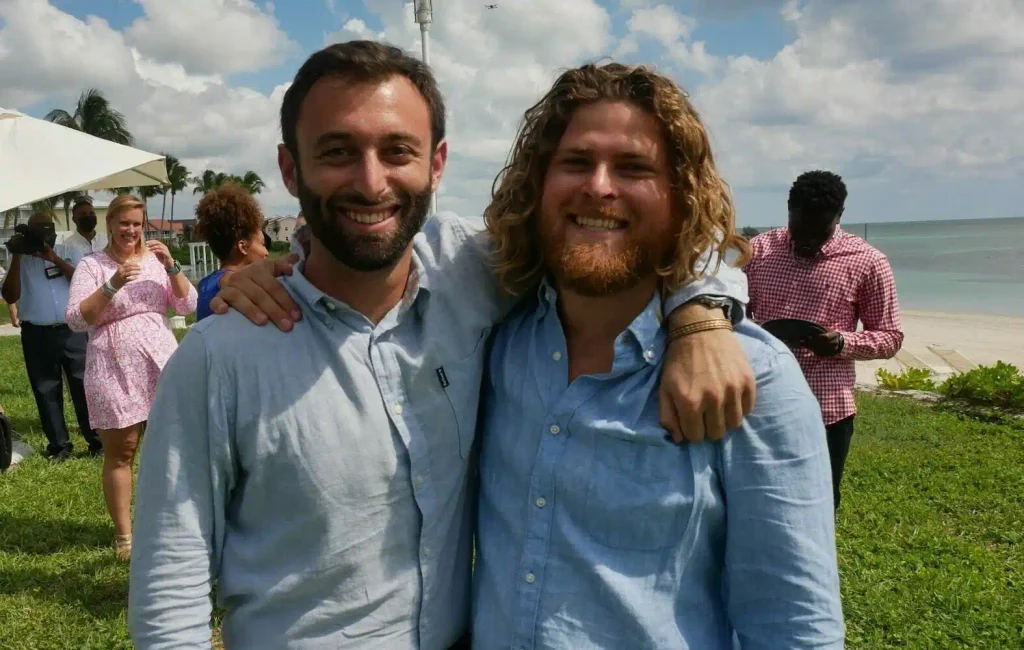
Founded by environmental entrepreneurs Sam Teicher and Gator Halpern, Coral Vita’s high-tech coral farms incorporate breakthrough methods to restore reefs in the most effective way possible. In 2021, the company was recognized as the inaugural winner of Prince William’s Revive Our Oceans Earthshot Prize Winner for their pioneering work in coral restoration.
To learn more about Coral Vita’s work or to get involved in coral reef conservation efforts, visit their website at www.coralvita.co or contact them directly through their Contact Us page.
FAQ
What is TNFD reporting?
TNFD reporting is disclosure of an organization’s nature-related dependencies, impacts, risks and opportunities, following the 14 recommended disclosures published by the Taskforce on Nature-related Financial Disclosures in September 2023. It is voluntary unless a jurisdiction requires it.
What does LEAP stand for?
LEAP stands for Locate, Evaluate, Assess and Prepare. It is TNFD’s four-phase method for finding where a business touches nature, identifying dependencies and impacts, assessing risks and opportunities, and preparing a response and disclosure.
Is TNFD reporting mandatory?
TNFD itself is voluntary. The ISSB is developing nature-related disclosure guidance that would also be voluntary unless a jurisdiction adopts it, and GRI 101 applies to organizations that report using GRI Standards. Check the rules in each market where you operate.
How is TNFD different from TCFD?
TCFD covered climate-related disclosures and disbanded in October 2023. TNFD covers nature-related dependencies, impacts, risks and opportunities, adds three disclosures to the TCFD set, and uses the same four pillars.
References
- https://www.kirkland.com/publications/kirkland-alert/2023/09/taskforce-for-nature-related-financial-disclosures-publishes-final-framework ↩︎
- https://tnfd.global/issb-decision-on-nature-related-standard-setting-drawing-on-tnfd-framework/ ↩︎
- https://tnfd.global/publication/recommendations-of-the-taskforce-on-nature-related-financial-disclosures/ ↩︎
- https://www.ifrs.org/sustainability/tcfd/ ↩︎
- https://tnfd.global/publication/additional-guidance-on-assessment-of-nature-related-issues-the-leap-approach/ ↩︎
- https://pmc.ncbi.nlm.nih.gov/articles/PMC4943730 ↩︎
- https://coralvita.co/coral-cafe/economic-impact-of-coral-reef-loss/ ↩︎
- https://www.societycorpgov.org/blogs/randi-morrison/2026/07/01/issb-targets-october-for-proposed-nature-disclosur ↩︎
- https://www.esgtoday.com/tnfd-to-pause-new-work-after-issb-takes-over-nature-reporting-standard-setting/ ↩︎
- https://globalreporting.org/news/news-center/transparency-standard-to-inform-global-response-to-biodiversity-crisis/ ↩︎
- https://sciencebasedtargetsnetwork.org/companies/take-action/act/ ↩︎