Blue carbon credits are carbon credits issued for protecting or restoring mangroves, seagrass meadows and tidal marshes, three coastal ecosystems that pull carbon dioxide out of the air and store most of it in waterlogged soil.1 2 3 Each credit stands for one tonne of carbon dioxide equivalent that was removed or kept out of the atmosphere, and an independent auditor has to verify the claim before a registry issues the credit. Coral reefs are not on the list. NOAA, IUCN and Conservation International each name the same three ecosystems, and none of them names reefs. Coral Vita restores reefs, so we write from the neighboring side of the coastline. This article covers how blue carbon credits are made, what the market looks like, which questions to ask before buying, and where a healthy reef matters to a blue carbon project.
Surface Notes
- Blue carbon credits come from mangroves, seagrass meadows and tidal marshes. NOAA, IUCN and Conservation International do not list coral reefs as blue carbon ecosystems.
- Most of the stored carbon sits in the soil, which makes measurement costly and explains why seagrass and salt marsh credits are rarer than mangrove credits.
- Verra’s VM0033 is the established restoration methodology. On 11 May 2026, Isometric announced that its mangrove restoration protocol became the first blue carbon protocol approved to carry the Core Carbon Principles label from the ICVCM.
- The market is small and concentrated in mangrove projects, and the only public price data we could verify is from 2022.
- Reefs, seagrass and mangroves protect the same shorelines, so reef condition belongs in the risk review of a coastal carbon site. Coral Vita does not generate or sell carbon credits.
Blue carbon credits come from three coastal ecosystems, and coral reefs are not one of them
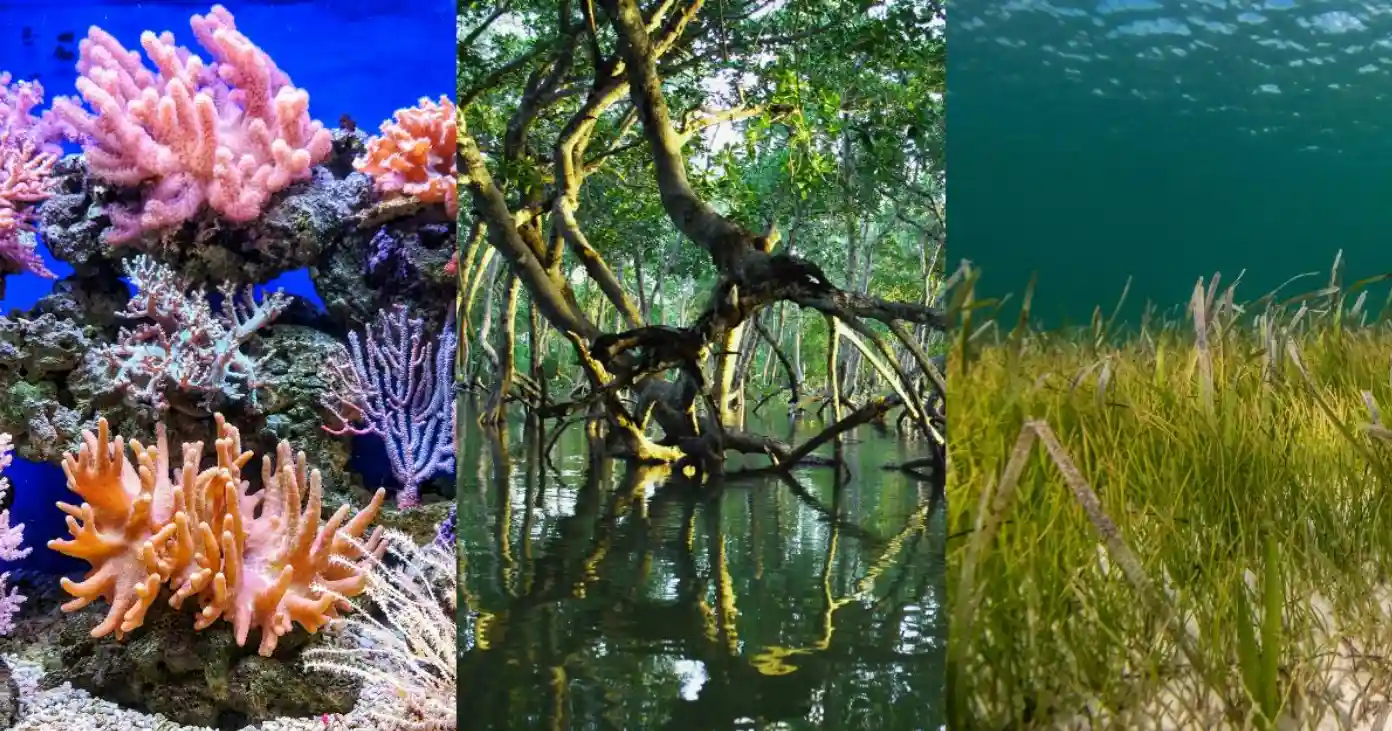
NOAA defines coastal blue carbon as the carbon captured by living coastal and marine organisms and stored in coastal ecosystems, and it names salt marshes, mangroves and seagrass beds. IUCN uses a nearly identical definition and lists mangroves, tidal marshes and seagrass meadows. Conservation International, which has run blue carbon programs for more than a decade and launched the International Blue Carbon Institute with the government of Singapore, names “mangroves, seagrasses and tidal marshes.”
These blue carbon ecosystems get attention because of how much carbon they hold. NOAA says mangroves and coastal wetlands sequester carbon each year at a rate about ten times greater than mature tropical forests, and that they store three to five times more carbon per equivalent area. Most of that carbon is in the soil, not in the plants above it. IUCN adds that, despite their small extent, these coastal ecosystems hold very large amounts of carbon in their soil, on a global scale, and that their destruction adds to human-caused greenhouse gas emissions. That is why protection can earn credits: when a mangrove stand is drained or cleared, the carbon in its soil can return to the atmosphere as carbon dioxide.
Coral reefs are a different case. We grow coral on land and plant it on degraded reefs, and our funding conversations would be easier if corals sequestered carbon in a way a registry could measure. They do not. The methodologies we reviewed, including Verra’s VM0033, cover tidal wetlands and seagrass, not reefs, and Coral Vita does not generate or sell carbon credits.
A blue carbon credit starts with a methodology, a baseline and a soil measurement
Project developers choose an ecosystem and an activity: restoring a drained tidal wetland, replanting mangroves, or protecting forest that would otherwise be cleared. They set a baseline that describes what would happen to the carbon without the project, measure the carbon in plants and soil, and report the difference. An independent verifier checks the work, and a registry issues one credit for each tonne of carbon dioxide equivalent.
The established restoration methodology is Verra’s VM0033, Methodology for Tidal Wetland and Seagrass Restoration. It sets out how to quantify net greenhouse gas reductions and removals from restoration, with credits earned mainly through increased biomass and soil organic carbon, and projects may be developed anywhere in the world.4 Version 2.1 has been active since 4 September 2023. It requires the latest AFOLU Non-Permanence Risk Tool to assess sea level rise risk, and it lets the project area change during the crediting period so wetlands can migrate landward. A major revision is under development, and earlier versions were written by Restore America’s Estuaries and Silvestrum.
Two kinds of project carry the blue carbon label, and a buyer should know which one they are looking at. A restoration project creates new growth that removes carbon dioxide from the air. A conservation project protects an ecosystem that would otherwise be cleared and counts the emissions that never happen. Abatable’s market analysis calls the second type “blue REDD+,” borrowing the name from forest credits built on the same logic, and expects the visible project pipeline to issue more than 13 million tonnes a year, mostly from mangrove avoided deforestation and degradation.5
Blue carbon projects range from community mangrove programs to developer-led pipelines
Mikoko Pamoja in Gazi Bay, Kenya is one of the best-documented community examples. Residents of the Gazi and Makongeni communities started it in 2010 with Plan Vivo and the Association for Coastal Ecosystem Services, and it protects 117 hectares of mangrove with full-time guards.6 From 2014 to 2018 the project generated 9,880 credits, and payments to the community from credit sales had totaled $58,591 at the time of the Commonwealth case study. The revenue pays a project manager and two guards, and it has bought books and clean water pumps for local schools. Nearly 500 community members take part in regular mangrove planting. The project is small, and its design shows what local communities can control in a credit project: who guards the forest and how the money is spent.
Seagrass and salt marsh projects are much rarer. Abatable reports that almost 90 percent of the fewer than 5 million blue carbon credits issued by the end of 2022 came from four mangrove restoration projects. The same analysis says that measuring soil carbon at depth underwater, together with the cost and red tape of securing marine rights, has held back seagrass and salt marsh credit generation. For project developers, those two constraints are the main reasons a seagrass meadow is harder to turn into a credit than a mangrove stand.
The voluntary carbon market for blue carbon is small, mangrove-heavy and slow to publish prices
The voluntary carbon market is where companies and investors buy credits by choice rather than because a rule requires it. Blue carbon is a small part of it. Abatable counted fewer than 5 million blue carbon credits issued by the end of 2022, compared with more than 400 million for REDD+, the forest category that blue carbon is often compared with. Abatable lists growing buyer awareness and falling confidence in REDD+ among the reasons demand is rising.
The price data we could verify is old. Abatable reports that the Delta Blue Carbon project sold all 250,000 of its 2021 vintage credits in November 2022 at $27.80 each, with more than 30 percent of bid volume above $35 a tonne. In the same period, a benchmark for nature-based credits fell from above $10 in January 2022 to below $3 in under a year, while buyers kept “a solid conviction for blue carbon.” Those are 2022 figures [VERIFY: current price range from a 2026 source such as a broker report or registry data].
Quality labels are the newer development. On 11 May 2026, Isometric announced that its Mangrove Restoration Protocol was the first blue carbon protocol approved by the Integrity Council for the Voluntary Carbon Market (ICVCM) to issue credits with the Core Carbon Principles (CCP) label.7 Isometric says an independent assessment found the protocol meets all ten principles, including permanence, additionality, transparency, independent verification and quantification. Isometric wrote that announcement about its own protocol, and the label applies to credits issued under that protocol, not to every blue carbon credit on the market. Carbon Pulse reported the same day that high-rated mangrove restoration credits had “surged to record highs” and that the ICVCM had confirmed another standard body and methodology met its bar, although the free summary does not include prices.8
Five questions to ask before buying blue carbon credits
A buyer comparing blue carbon projects can get most of the way to a decision with five questions.
- Which registry and methodology issued the credit, and are the project documents public? A project under VM0033 can be read against the methodology, line by line.
- Is the credit a removal or an avoided loss, and how was the baseline set? Avoided-loss credits depend on a claim about what would have happened without the project, so the baseline deserves the most scrutiny.
- How was soil carbon measured, and how often is it re-measured? Soil is where most of the carbon sits, and measuring it underwater is hard.
- How does the project handle rising sea levels? VM0033 version 2.1 requires a sea level rise risk assessment and allows the project area to shift landward, so ask what the developer’s plan is if the site floods deeper than the habitat tolerates.
- Who benefits locally, and does a quality label apply? Mikoko Pamoja shows what community payments look like, and the CCP label shows whether an outside body has tested the protocol.
Buyers also need to decide what the credit is for. A carbon offset claim says a credit cancels an equal amount of the buyer’s own emissions. Some companies instead buy credits as a contribution alongside their own cuts. Either way, a credit does not change the buyer’s own emissions, and it removes carbon dioxide through living ecosystems that carry biological and sea level risk. Direct air capture, by comparison, removes carbon dioxide with machines and carries a different set of risks. A buyer weighing the two should read each project’s documents rather than compare the labels. For the wider set of nature finance tools beyond carbon, our guide to conservation finance covers the other instruments, and our explainer on biodiversity credits covers the units that measure biodiversity outcomes rather than carbon.
Reefs, seagrass and mangroves protect the same shorelines, so reef condition belongs in a blue carbon risk review
Coral reefs, seagrass meadows and mangroves protect coastlines together, and a coastal carbon project sits inside that system. A 2016 PLoS ONE study by Guannel and colleagues modeled idealized coastlines based on Belize and compared them with live coral, dead coral and no coral.9 With dead coral, nearshore waves were 35 percent higher on a barrier reef profile and 50 percent higher on a fringing reef profile than with live coral. With one meter of sea level rise, a dead and bare barrier reef produced nearshore waves 3.5 times higher, and a fringing reef produced waves 4 times higher. The authors concluded that live corals, seagrasses and mangroves together supply more protection than any single habitat does.
For a developer crediting mangroves or seagrass behind a reef, the finding matters because the waves reaching the shore are larger when the reef is dead, and larger waves put more physical stress on the habitat being credited. The study has limits. It uses idealized profiles rather than a specific site, and it models wave protection, not carbon. It does not tell us how much carbon a mangrove stand loses when the reef in front of it declines. We have not found a study that measures how reef restoration changes the carbon stored in neighboring mangrove or seagrass soils, so we do not claim that it does.
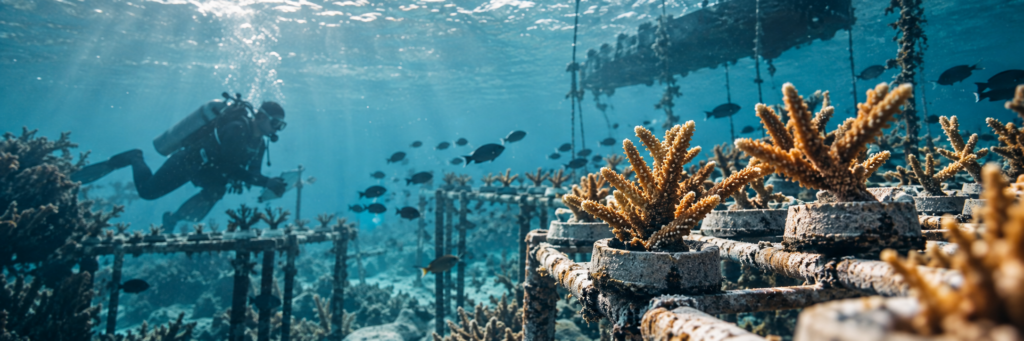
What we can say is narrower and still useful. Reef condition is a physical risk factor for the coastal habitats behind it, and it belongs in the same site review as sea level rise and sediment supply. Coral Vita grows coral on land in months instead of the decades it takes in nature, and we have grown more than 100,000 corals across 52 species for restoration in the Bahamas, Saudi Arabia and the UAE. We won the inaugural Revive Our Oceans prize in Prince William’s Earthshot Prize in 2021. Our restoration and mitigation services include replanting degraded reef and relocating coral from construction zones, and our piece on coastal adaptation explains how reefs fit into shoreline defense.
What to ask before committing to a coastal carbon project
Developers and buyers evaluating a coastal carbon project can add one question to the standard checklist: is there a reef offshore, and what condition is it in? If the answer is a degraded reef, or a planned port or coastal build that will disturb one, talk to a reef restoration team early, before the project’s risk assessment is fixed. A reef team cannot add carbon credits to the project. It can tell you what the reef is doing for the shoreline today and what it would take to restore that protection. Contact Coral Vita through our services page if your site fits that description.
About Coral Vita
Coral Vita is a mission-driven company dedicated to restoring our world’s dying and damaged reefs. Using innovative land-based farming techniques, Coral Vita grows diverse and resilient corals in months instead of the decades they take in nature. These corals are then transplanted into threatened reefs, helping to preserve ocean biodiversity while protecting coastal communities that depend on healthy reefs for protection, food, and income.
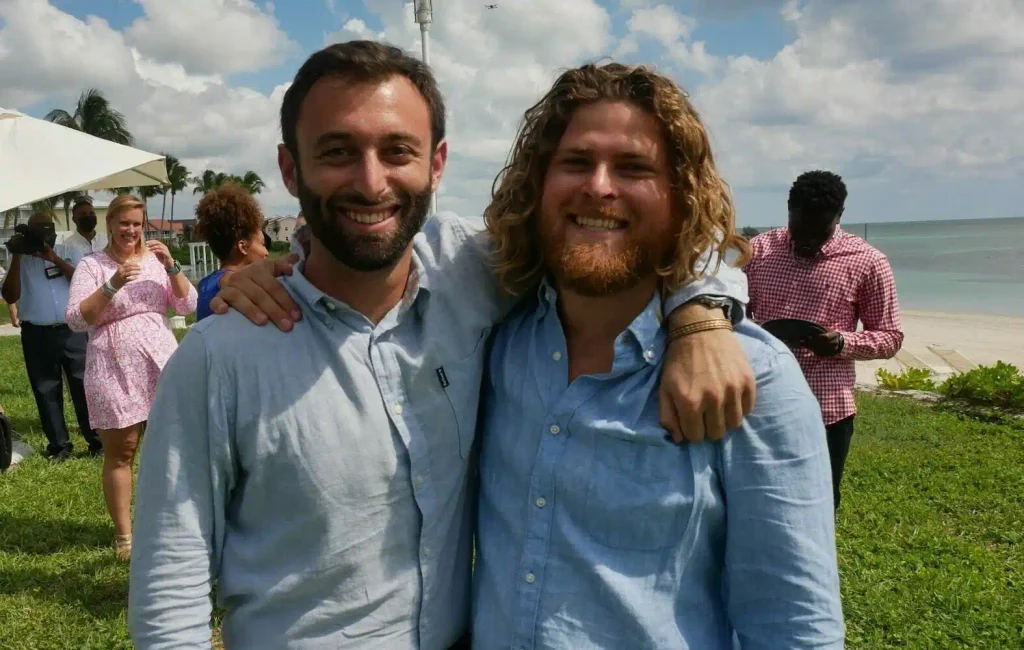
Founded by environmental entrepreneurs Sam Teicher and Gator Halpern, Coral Vita’s high-tech coral farms incorporate breakthrough methods to restore reefs in the most effective way possible. In 2021, the company was recognized as the inaugural winner of Prince William’s Revive Our Oceans Earthshot Prize Winner for their pioneering work in coral restoration.
To learn more about Coral Vita’s work or to get involved in coral reef conservation efforts, visit their website at www.coralvita.co or contact them directly through their Contact Us page.
FAQ
What are blue carbon credits?
Blue carbon credits are carbon credits issued for protecting or restoring mangroves, seagrass meadows and tidal marshes. Each credit represents one tonne of carbon dioxide equivalent removed or kept out of the atmosphere, verified by an independent auditor under a registry methodology.
Do coral reefs count as blue carbon?
No. NOAA, IUCN and Conservation International define blue carbon ecosystems as mangroves, seagrasses and salt or tidal marshes. Verra’s VM0033 methodology covers tidal wetland and seagrass restoration. Reef restoration protects shorelines but does not generate blue carbon credits.
How is a blue carbon credit verified?
A developer measures carbon in plants and soil against a baseline, following a registry methodology such as Verra’s VM0033. An independent verifier audits the measurements, and the registry issues one credit per tonne of carbon dioxide equivalent.
Is a blue carbon credit the same as a carbon offset?
A credit is the unit; an offset is how a buyer uses it. A buyer claiming an offset says the credit cancels an equal amount of its own emissions. Some buyers purchase credits as a contribution alongside their own reductions instead.
References
- https://oceanservice.noaa.gov/ecosystems/coastal-blue-carbon/ ↩︎
- https://iucn.org/resources/issues-brief/blue-carbon ↩︎
- https://www.conservation.org/blue-carbon ↩︎
- https://verra.org/methodologies/vm0033-methodology-for-tidal-wetland-and-seagrass-restoration/ ↩︎
- https://abatable.com/blog/blue-carbon ↩︎
- https://thecommonwealth.org/case-study/case-study-community-led-mangrove-restoration-and-conservation-gazi-bay-kenya-lessons ↩︎
- https://isometric.com/writing-articles/icvcm-approves-isometrics-mangrove-restoration-protocol ↩︎
- https://carbon-pulse.com/510751/ ↩︎
- https://pmc.ncbi.nlm.nih.gov/articles/PMC4943730 ↩︎