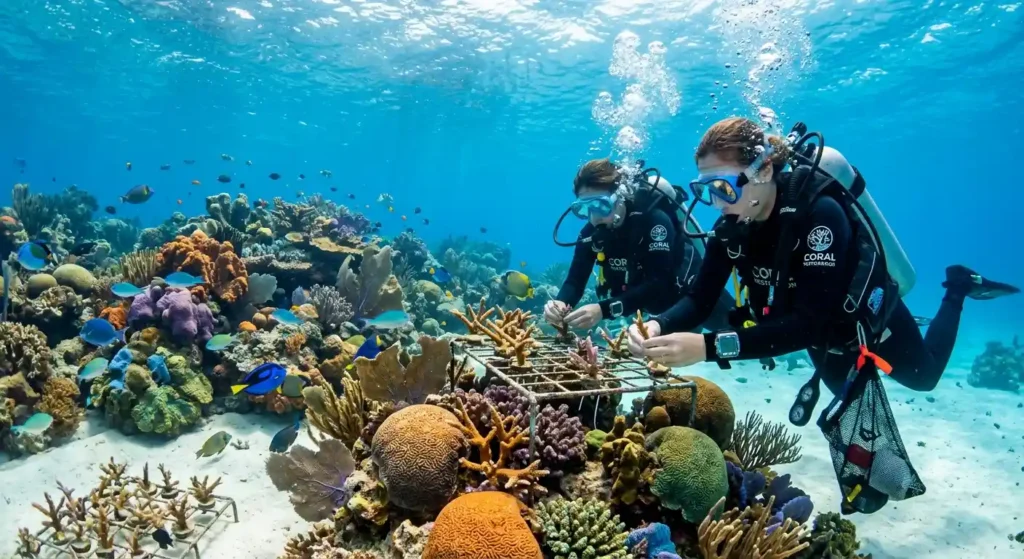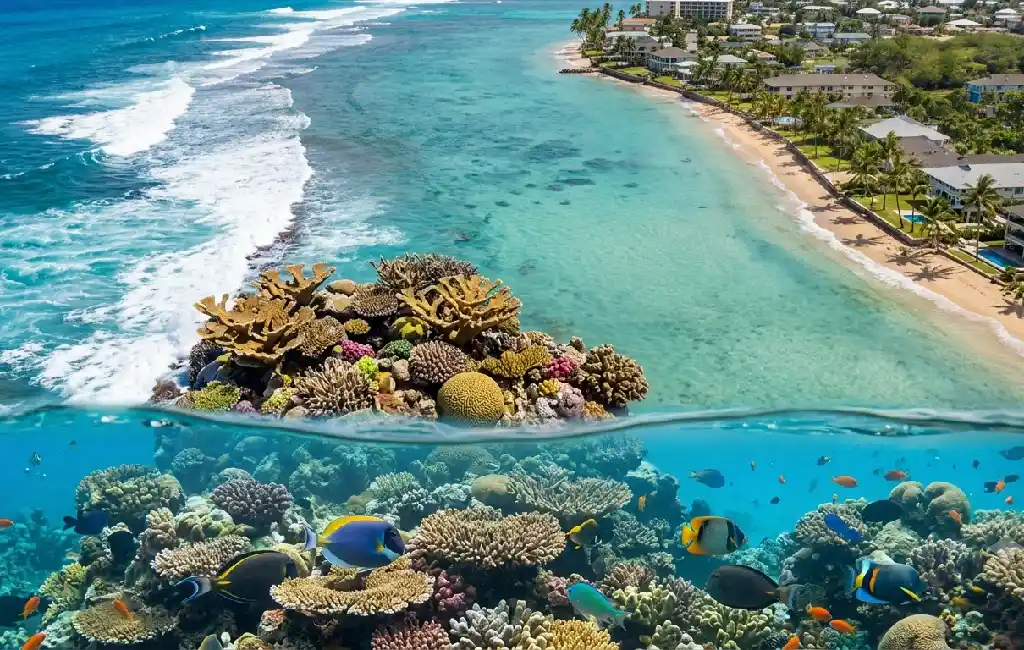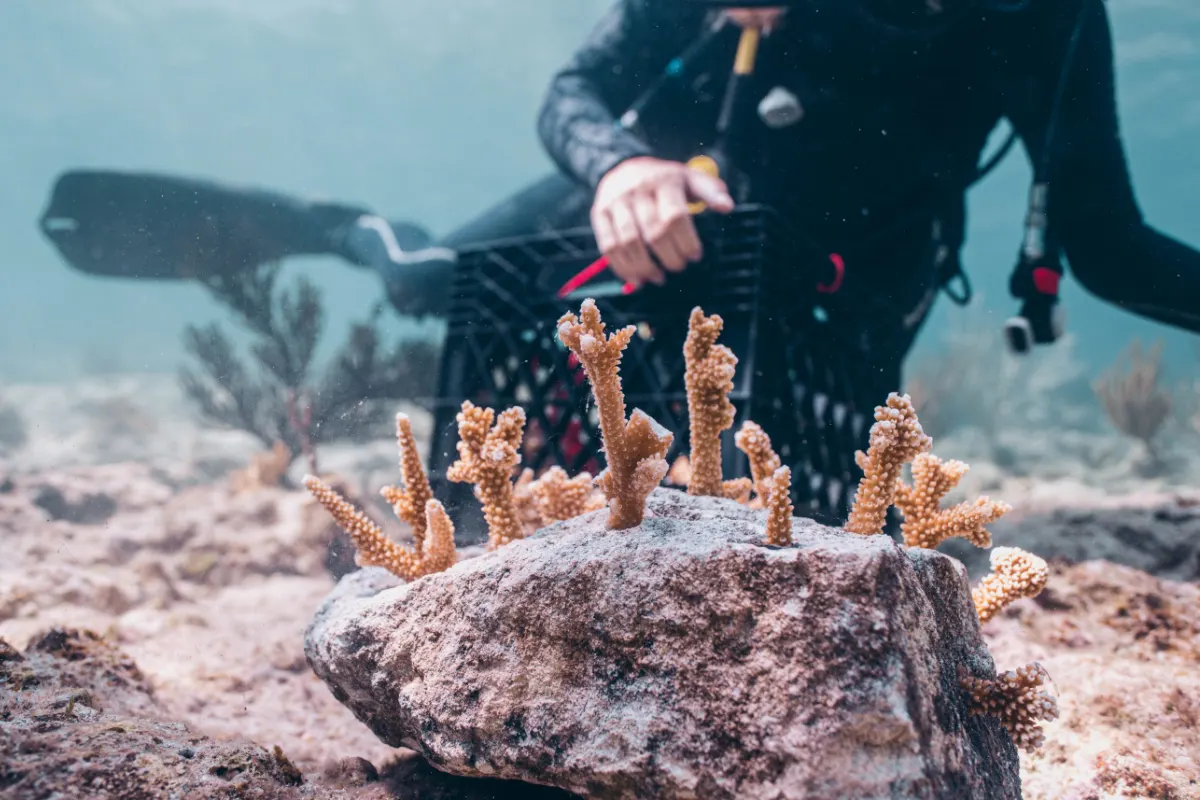
Coral relocation means moving living coral colonies out of the footprint of a planned project and reattaching them at a safe site nearby, so the project can go ahead with less coral lost. It is a mitigation tool. It does not make a destructive project harmless, it does not replace avoiding the reef, and its results depend heavily on how far the corals move, how large they are and how long anyone keeps checking on them. This guide is for the port authorities, contractors, developers and lenders who have to decide when relocation is required, how it runs, and what to ask the people who do it. If you are trying to restore a reef that no project threatens, our piece on coral transplantation explains the difference.
The Short Version
- Relocation sits inside the mitigation hierarchy of avoid, minimize, restore and offset. It is a way to minimize an impact. It is not an offset.
- A 2025 guide published by AD Ports Group and written by NYU Abu Dhabi’s Dr. John Burt says relocation “should be considered only as a last resort measure where coastal development is to occur.”
- A well-run relocation follows seven steps, from a baseline survey through attachment to monitoring and reporting.
- Survival varies widely. At Hayman Island in Queensland, 94.6 percent of moved corals were alive after 12 months and 77.5 percent after two years, while a relocation in Iran reportedly saw about 30 percent survive.
- Ask any provider about survey method, where corals are held if the receiving site is not ready, how long monitoring lasts, what counts as success, and what happens if it falls short.
When a project needs coral relocation: permits, lenders and the mitigation hierarchy
Relocation is rarely a choice made in isolation. It shows up because a permit condition, a planning approval or a lender’s environmental standard asks for it. The framework most lenders point to is IFC Performance Standard 6, which sets a mitigation hierarchy of avoid, minimize, restore and offset, with avoidance “as a matter of priority.”1 It asks for no net loss of biodiversity in natural habitat “where feasible,” and a net gain for the values that qualify an area for the standard’s most sensitive habitat category.2
Relocation is a way to minimize an impact. It does not count as an offset, because an offset compensates for what is still lost after avoidance and minimization, usually somewhere else. Moving a colony 100 meters out of a channel does not compensate for the reef that gets built over. In the United States the term for compensation is compensatory mitigation, and the U.S. Coral Reef Task Force published a handbook on avoidance, minimization, and compensatory mitigation and restoration in December 2016.3 4 For port and dredging work, the PIANC guide “Dredging and port construction around coral reefs,” published in 2010 with UNEP, is the industry reference.5 The impact that creates the need is covered in our piece on dredging and coral reefs.
The most direct guidance for the Arabian Gulf is blunt. A guide led by Dr. John Burt of NYU Abu Dhabi and published by AD Ports Group says “coral relocation should be considered only as a last resort measure where coastal development is to occur.”6 I agree with that. Avoid the reef wherever the design allows, and relocate what cannot be avoided.
Two connections are worth knowing. If your project is in the UK, biodiversity net gain is a separate planning obligation, and a coral move does not satisfy it. If your company reports under TNFD, relocation is one possible response to an impact found in the assessment, and our TNFD reporting guide covers that process.
How a coral relocation runs, step by step
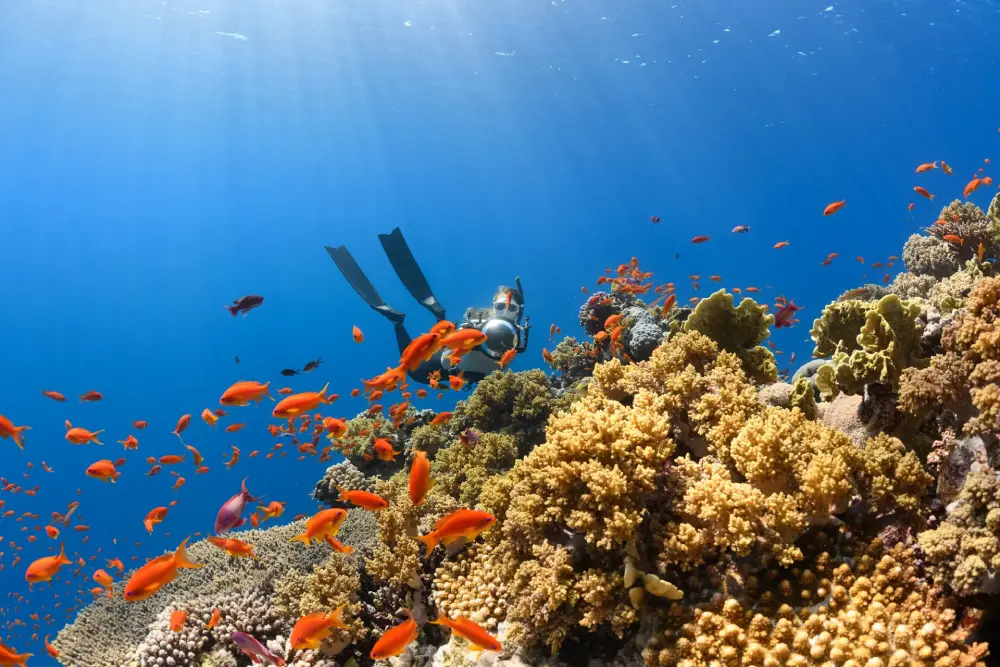
The details change with the site, but a well-run relocation follows the same seven steps.
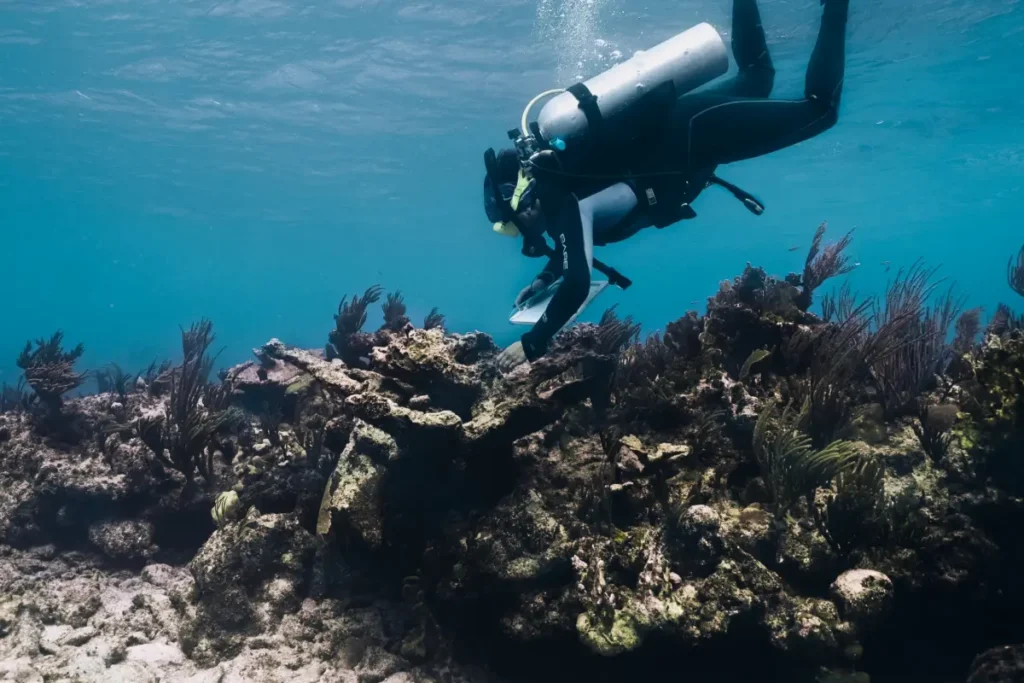
- Survey and map the colonies in the footprint. Count them, record species, size and health, and map where each one sits. The AD Ports guide gives priority to healthy, sexually mature colonies and says colonies larger than 10 centimeters in diameter may be used.
- Agree the permit and method statement. The regulator approves a written method, and the success threshold is set before any coral is touched.
- Choose the receiving site. The AD Ports guide says recipient sites should be close to the donor site and the staging area, that sites with chronically high turbidity and sedimentation “must be avoided,” and that bare reef framework or rock are ideal surfaces. A review of a relocation in Kāne’ohe Bay, Hawaii recommends limiting the method to areas not exposed to storm surf or continuing human pressure, with short transport distances and similar donor and receiving sites.7 The guide also recommends a pilot of the proposed methods before the full move.
- Time the move around heat and storms. I would not schedule a move into the hottest weeks of the year or into storm season, and I would build in room to delay if the water warms.
- Detach and transport the colonies. Whole colonies are the preferred approach in the AD Ports guide. They are lifted with as little damage as possible and moved the shortest practical distance.
- Attach them at the receiving site. At Hayman Island, for a 170 meter wastewater pipeline built in 2020, 204 corals were detached, moved between 20 and 100 meters and attached to bare rock with a concrete mix.8 The AD Ports guide warns that survival is low if no manual attachment methods are used.
- Monitor and report. Survival counts, health scoring and photographs at fixed intervals, with reports to the regulator. The interval and the survival level that triggers a remedy are agreed in step 2.
What survival to expect from coral relocation: read the monitoring period first
Survival figures only mean something with a monitoring period attached. The Hayman Island study is a good example of how much that matters. Survival was 94.6 percent at 12 months and 77.5 percent at two years, and smaller corals survived better. The authors compare those results with a global average of 64 percent for relocated corals. Same corals, one more year of monitoring, about 17 points lower.
The Dubai case is the best-known in the Gulf. In the late 2000s, Nakheel moved a reef from the Dubai Drydocks breakwater to The World breakwater: “more than 1,100 coral-encrusted rocks, each weighing about 5 tonnes.” The National reported in August 2013 that “only about seven per cent of the coral was destroyed” and that the reef was flourishing five years later, and quoted John Burt on more than 20,000 coral colonies spared.9 The AD Ports guide describes the same move as more than 22,000 corals on 1,100 coral-covered stones relocated 18 kilometers. That is a press account and a guide’s summary, not a monitoring report, so I would treat the seven percent figure as a claim and not as a measured survival rate.
Relocation can also go badly. A New York Times article from December 2023 reports a researcher’s relocations in Iran in which “only about 30% of them survived.”10
I read these cases the same way. Short moves of small colonies to similar nearby habitat do well. Long moves, large colonies and exposed receiving sites do worse. And a project that reports survival at 12 months and says nothing after the first summer has not told you much.
Coral relocation in the Arabian Gulf: Khalifa Port and the AD Ports guide
Relocation is becoming routine in the Gulf’s port work. In February 2021, Abu Dhabi Ports relocated corals at Khalifa Port from the northern revetment to the port’s environmental breakwater, under the supervision of the Environment Agency Abu Dhabi, as one of “a series of mitigation measures to lessen the environmental impact from dredging.”11
On 29 April 2025, AD Ports Group and NYU Abu Dhabi published “Coral Relocation in the Arabian Gulf: Benefits, risks and best-practices recommendations for practitioners and decision-makers,” the output of a three-year project.12 It is the most relevant regional guidance I know of. Besides the last-resort position, it says that sites with pollution, algal overgrowth or overfishing must be disqualified if those stressors cannot be removed, and that a pilot study of the proposed methods is “highly recommended.” If you are planning a relocation in the Gulf or the Red Sea, read it before you write a method statement.
Our own work in the region is different. Coral Vita opened a demonstration centre at Mina Rashid in Dubai with DP World in December 2023, run as a pilot in collaboration with the Dubai municipality. DP World’s release says the partners will explore opportunities to integrate coral farming and restoration into its ports network.13 That is a pilot, not a relocation project, and I do not want it read as one.
What coral relocation does not fix
It is not an offset. A moved colony is a colony saved, and the reef under the new quay is still gone.
It is not equally good at all sizes. At Hayman Island smaller corals survived better, and the AD Ports guide prefers whole colonies, so large old colonies are where I would expect the most trouble. Any provider who says size does not matter should show you data.
It does not replace avoidance. The guide’s position that relocation is a last resort is the right one, and a design that keeps a channel off the best reef will beat any relocation plan.
And it does not fix the receiving site. The Kāne’ohe Bay review cautions that restoration on reefs with ongoing poor land management or severe bleaching may be futile. If the receiving reef is under chronic pressure, moving corals onto it moves the loss, and does not prevent it.
What to ask a coral relocation provider
Five questions will tell you most of what you need.
- How will you survey and map the colonies, and who verifies the count before the move?
- Where will corals be held if the receiving site is not ready, or if a heat event hits mid-project? Land-based tanks are one answer, and this is one reason we built our farms the way we did.
- How long will you monitor, at what intervals, and who receives the reports? Ask for years, not months.
- What survival level counts as success, and what do you do if the result falls short?
- Does the offer include restoration of the surrounding reef after construction, or only the move?
That last question matters for the budget. If a port is going to be built and corals are in the way, moving them can help the project get the permits it needs. Some clients then add restoration work on top of the move. Our guide to coral reef restoration explains what that second stage involves.
Coral Vita offers coral relocation and restoration as services, described on our services page. I would rather you ask hard questions of every provider, including us, than sign off on a plan you cannot check. If you have a project in the Gulf, the Caribbean or The Bahamas, send us the site and the timeline.
About Coral Vita
Coral Vita is a mission-driven company dedicated to restoring our world’s dying and damaged reefs. Using innovative land-based farming techniques, Coral Vita grows diverse and resilient corals in months instead of the decades they take in nature. These corals are then transplanted into threatened reefs, helping to preserve ocean biodiversity while protecting coastal communities that depend on healthy reefs for protection, food, and income.
Founded by environmental entrepreneurs Sam Teicher and Gator Halpern, Coral Vita’s high-tech coral farms incorporate breakthrough methods to restore reefs in the most effective way possible. In 2021, the company was recognized as the inaugural winner of Prince William’s Revive Our Oceans Earthshot Prize Winner for their pioneering work in coral restoration.
To learn more about Coral Vita’s work or to get involved in coral reef conservation efforts, visit their website at www.coralvita.co or contact them directly through their Contact Us page.
Frequently asked questions
What is coral relocation?
Coral relocation is moving living coral colonies out of the footprint of a planned project, such as a port or pipeline, and reattaching them nearby so fewer corals are lost. It is a mitigation tool, not an offset.
Does coral relocation work?
Sometimes. At Hayman Island, 94.6 percent of moved corals were alive after 12 months and 77.5 percent after two years. A relocation in Iran reportedly saw about 30 percent survive. Distance, colony size and monitoring length matter.
Is coral relocation the same as coral transplantation?
Relocation is one use of coral transplantation: moving existing colonies out of a project’s way. The other use is outplanting, where nursery-grown corals are planted on a degraded reef to restore it.
Who pays for coral relocation?
Usually the project owner or contractor, because a permit, planning condition or lender standard requires it. Costs vary widely by site, and published cost figures are scarce, so ask providers to price survey, move and monitoring separately.
References
- https://www.iaia.org/downloads/WAB-PS6-training.pdf ↩︎
- https://thebiodiversityconsultancy.com/our-work/our-expertise/strategy/performance-standards ↩︎
- https://www.epa.gov/cwa-404/handbook-coral-reef-impacts-avoidance-minimization-and-compensatory-mitigation-and ↩︎
- https://coralreef.gov/mitigation_handbook.html ↩︎
- https://wesr-search.unep.org/ckan/dataset/unep-wcmc-rsrc-report-pianc-dredging-and-port-construction-around-coral-reefs ↩︎
- https://www.adportsgroup.com/wp-content/uploads/sites/38/2026/06/ADPG_CoralRelocationGuide_2025_Eng_5ac098.pdf ↩︎
- https://peerj.com/articles/3346 ↩︎
- https://www.jcu.edu.au/news/releases/2024/april/reef-management-techniques-potentially-coral-saving ↩︎
- https://www.thenationalnews.com/uae/environment/relocated-to-the-world-dubai-coral-reef-flourishing-in-new-home-1.285957 ↩︎
- https://www.sanjuandailystar.com/post/coral-reefs-are-in-trouble-one-lab-in-the-desert-is-trying-to-help ↩︎
- https://cruise-arabia.com/2021/02/13/abu-dhabi-cruise-terminal-operator-launches-massive-coral-relocation-project/ ↩︎
- https://www.adportsgroup.com/en/news-and-media/2025/04/29/ad-ports-group-and-nyu-abu-dhabi-issue-coral-relocation-in-the-arabian-gulf-report ↩︎
- https://www.dpworld.com/news/releases/dp-world-and-coral-vita-open-the-uaes-first-restorative–educational-coral-exhibition/ ↩︎